
Your needs, this model
Does it fit your priorities?
Does Bluetooth make the AT-LP120XBT-USB automatic?
No. Bluetooth changes the signal route, not tonearm operation: the manual describes hand cueing and manual return/START/STOP. Use LINE for Bluetooth and follow the receiver's pairing instructions.
Explore this need in the finder →Can I connect it to either receiver PHONO or powered speakers?
Yes as separate analog arrangements: select PHONO for a compatible receiver PHONO input (and connect ground as required), or select LINE for powered speakers or an amplifier line input. Do not feed LINE into PHONO; the turntable has no built-in speakers.
Explore this need in the finder →Will its USB and Bluetooth features digitize and play the same way?
No: Bluetooth sends audio to a paired receiver, while USB connects to a computer for recording software. The page lists 16-bit 44.1/48 kHz USB audio and USB 2.0 compatibility; check your computer software and receiving device, and use LINE for both documented routes.
Explore this need in the finder →The AT-LP120XBT-USB-USBBK is the black U.S. edition of a fully manual direct-drive turntable that combines Bluetooth, USB capture and wired RCA output. Its selling distinction is not automatic playback; the user still cues the arm, returns it and stops the platter. Instead, it offers several possible ways to move audio from the same record: a receiver or wired speaker system, a computer, or a paired Bluetooth receiver. This assessment is based on Audio-Technica's U.S. product page and model-specific manual, not personal use or comparative listening.
Bluetooth adds a route, not an automatic arm
The product page describes it as modeled on the AT-LP120XUSB with Bluetooth added to existing analog and USB connections. The DC servo direct-drive motor, three speeds (33⅓, 45 and 78 RPM), balanced S-shaped arm and stock AT-VM95E cartridge remain part of a manual deck. The manual shows the listener starting the platter, lifting and placing the arm, then raising and returning it and pressing START/STOP at the end. It does not document automatic start, arm lift/return or end-of-record platter stop. Someone who wants hands-off playback should look at a fully automatic model rather than mistake wireless convenience for tonearm automation.
Bluetooth is listed as version 5.0 with A2DP and SBC, aptX and aptX Adaptive codec support. The manual requires LINE mode for Bluetooth and describes pairing a receiving device such as compatible wireless headphones or active speakers. Receiver capability, pairing state and placement matter. The codec list is a transmitter specification, not a promise that every speaker or headphone will connect using the highest listed codec. Check the actual receiving device's instructions and supported codecs; the turntable does not include wireless speakers.
Keep analog and phono settings straight
The built-in phono stage is switchable. For a receiver or integrated amplifier with a compatible PHONO input, set the selector to PHONO and follow the manual's grounding instructions. For powered speakers with a line input, select LINE. The same LINE position is used for an amplifier AUX/line input, as well as the documented USB and Bluetooth connections. This switch is not cosmetic: a line-level output and a phono-level input are not interchangeable. The deck can feed a range of system arrangements, but does not itself supply speaker amplification or contain speakers.
Its detachable analog RCA cable and ground, external AC adapter and built-in stage give a wired fallback if you choose not to pair a receiver or do not want a wireless route. The 1.9 m USB cable serves a separate computer-capture purpose. The U.S. page lists selectable 16-bit 44.1 or 48 kHz USB conversion and a USB 2.0 computer interface; compatible recording software and a computer are still needed. A Bluetooth path sends audio to a compatible receiver, while USB sends it to a computer. Treat them as separate intended destinations rather than assuming one will perform or record the other's job.
Setup and cartridge changes still take care
The supplied AT-VM95E cartridge is mounted on a detachable AT-HS6 universal headshell. That mount leaves a practical upgrade path: the VM95 stylus family offers replacement options, and the headshell/cartridge can be changed. A complete cartridge swap involves alignment and rebalancing; the manual also instructs the owner to set tracking force and matching anti-skate. It lists 2.0 g as the stock cartridge's standard force, within its stated 1.8–2.2 g range. This is adjustable manual hardware, not a promise that an arbitrary cartridge will be compatible or correctly set up.
The official package list includes the platter and felt mat, removable hinged cover, counterweight, cartridge/headshell, 45 adapter, stylus target light, USB cable, grounded RCA cable and adapter. Initial setup requires installing the platter and mat, leveling the body and balancing the arm. On used or refurbished units, verify that those pieces are present and that the stylus guard, stylus and electrical adapter are in the condition expected for the exact offer. The page's support for 78 RPM also should not be read as evidence that the supplied elliptical AT-VM95E stylus is a 78-specific option; confirm the appropriate stylus before playing shellac records.
The shared footprint is a real constraint
Audio-Technica lists a 17.80-inch width, 13.86-inch depth and 5.57-inch height, with 8 kg weight excluding the dust cover. The dimensions match the USB-only LP120XUSB, so the Bluetooth model does not solve a space problem. Allow additional area for cable bends, control access, tonearm movement and opening or removing the cover. It is a broad, substantial platform, and the published body numbers alone cannot establish a safe operating shelf.
How it differs from the LP120XUSB
The AT-LP120XUSB has wired RCA and USB but no documented Bluetooth. The LP120XBT-USB adds Bluetooth 5.0/aptX-family support and lists USB 2.0 rather than USB 1.1 for its computer interface. Both retain manual cueing, a switchable phono stage, 78-RPM selection, an AT-VM95E on detachable headshell and the same body dimensions. The BT variant's published pitch adjustment range also differs from the USB-only model's manual specification, so the product versions should remain separate rather than being merged as finish-only choices.
The current U.S. product selector lists AT-LP120XBT-USBWH as the white finish alongside the black USBBK code. The manufacturer’s Japanese LP120XBT-USB page supplies the separately inspected white-finish image below. That is evidence of the colorway, not proof of a U.S.-specific box, barcode, stock or retail offer; the functional assessment still relies on the U.S. family page and manual.
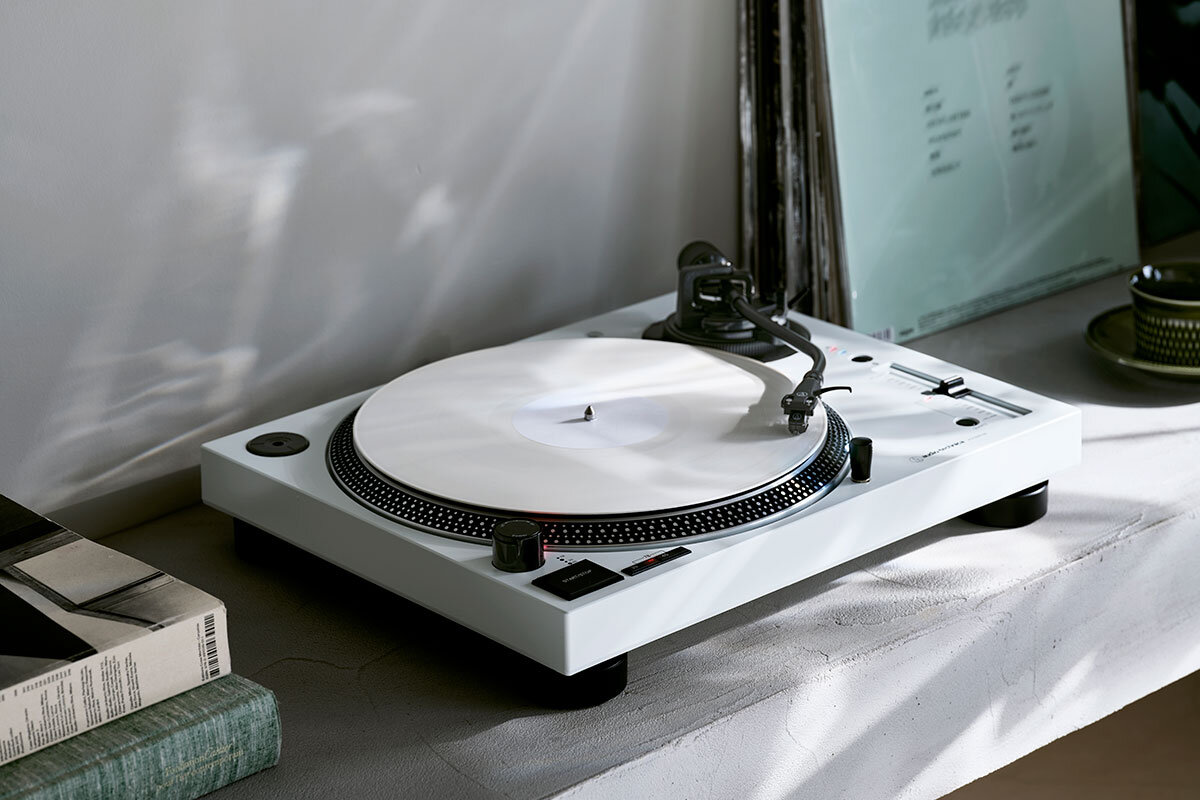
Choose this edition when the wireless path is a genuine system requirement alongside USB or analog connections, and you accept pairing checks, manual handling and the large chassis. If Bluetooth is not needed, compare the USB-only model without assuming the extra wireless hardware improves sound. The U.S. selector displays black USBBK and white USBWH finish codes. An exact white-finish image from the official Japanese model page is now shown below; it verifies the colorway only, not a U.S.-specific package or retail offer. The functional specification and central buying action remain tied to black USBBK. No wireless test, audio measurement, ownership, price, stock or review-rating claim is made.
Primary references: Audio-Technica AT-LP120XBT-USB U.S. product page and AT-LP120XBT-USB U.S. user manual. The official Japanese LP120XBT-USB product page is cited for the white-finish image only.
Key specifications
Key details at a glance
| Drive | Direct drive |
|---|---|
| 78-RPM play option | Yes |
| Included cartridge | Audio-technica at-vm95e moving-magnet cartridge mounted to at-hs6 detachable universal headshell |
| Built-in phono preamp | Yes |
| Manual tonearm cueing | Yes |
| End-of-record platter stop | No |
| Removable cartridge body or headshell | Yes |
| USB audio capture to computer | Yes |
| Bluetooth audio transmission | Yes |
| Platter | Die-cast aluminum |
| Platter mat | Felt |
| Body width | 17.8 in |
| Body depth | 13.86 in |
| Body height | 5.57 in |
| Published phono output | 4 mV |
Use the exact model’s instructions for operating limits, supplied equipment and version differences.
Sources for this review
Sources for this assessment
Check your phono route before choosing
Check each model's documented input route, arm operation, and body limits. Use the finder to compare supported phono-system arrangements without assuming adjacent models share features.