
Your needs, this model
Does it fit your priorities?
Can the AT-LP120XUSB connect to my active speakers without a separate phono box?
Yes, if those speakers have a compatible line input: select LINE on the built-in phono-preamp switch and connect RCA. Select PHONO instead when feeding a compatible receiver PHONO input. Neither route provides speakers in the turntable package.
Explore this need in the finder →Can I transfer records to my computer with this deck?
The manufacturer lists an included USB cable and 16-bit capture at 44.1 or 48 kHz over a USB 1.1 interface. The manual says to use LINE for the USB path; a compatible computer and recording application are still needed, so check its operating-system and software support.
Explore this need in the finder →Can it play a 78 and then stop itself?
Its speed controls include 78 RPM, but the supplied cartridge is an AT-VM95E rather than a stated 78-specific stylus, so confirm the appropriate stylus and record requirements before use. The arm is manual and the manual's stop routine requires lifting and returning it and pressing START/STOP; automatic end stop is not documented.
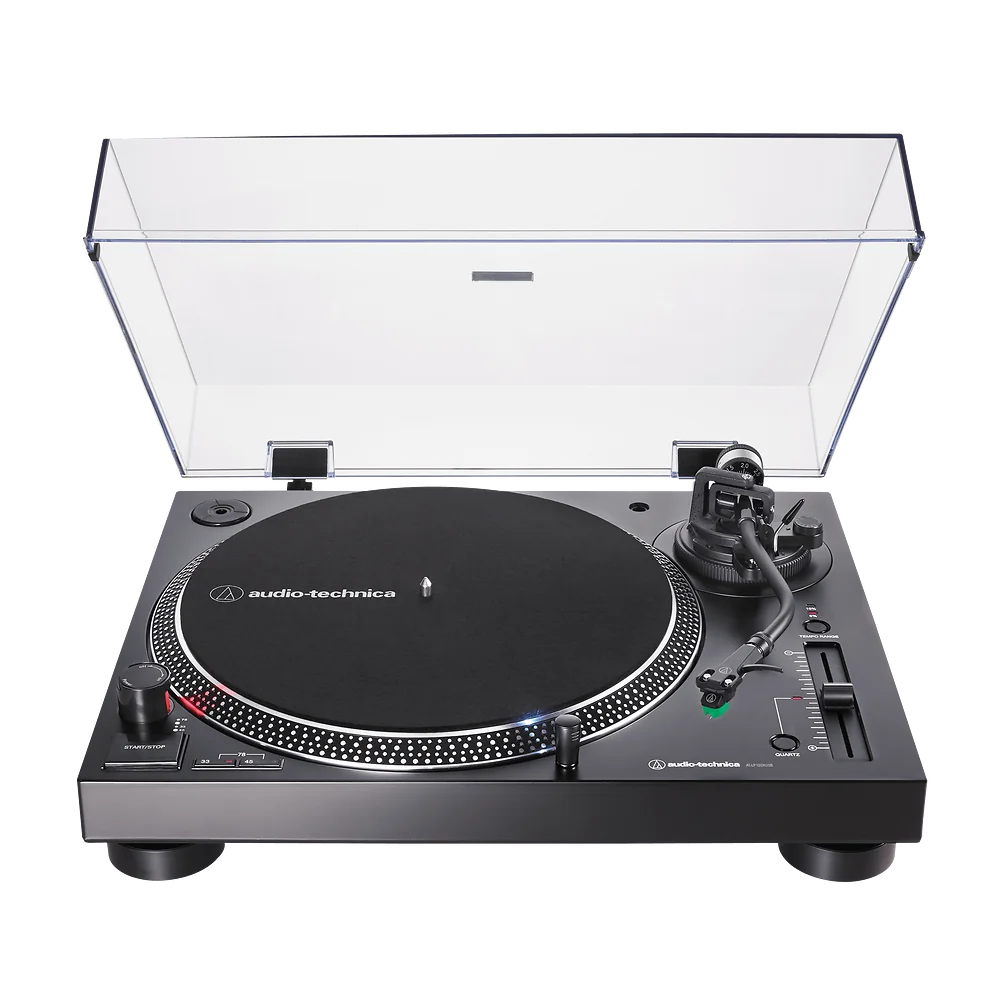
Explore this need in the finder →The AT-LP120XUSB-BK is a large, hands-on direct-drive turntable for someone who wants three record speeds, conventional analog connections and a path to computer recording without giving up a removable cartridge mount. It is fully manual: the user places and lifts the arm, returns it to rest and stops the platter. The U.S. page lists separate black and silver editions; this assessment and its image cover the black AT-LP120XUSB-BK only. This is a research-based reading of Audio-Technica's page and manual, not a listening test or claim of ownership.
Manual handling is a central part of the package
The deck is driven by a DC servo direct-drive motor and the manufacturer specifies 33⅓, 45 and 78 RPM. Its manual shows the user selecting a speed, pressing START/STOP, raising the lift, moving the tonearm and lowering it onto the groove. To finish, the listener raises and returns the arm before pressing the stop button. There is no automatic arm placement, end-return or documented platter auto-stop. That makes this a poor fit if you want a fully automatic start-and-finish routine, but a relevant option when you prefer a manual arm and direct-drive controls.
The speed and pitch controls provide more choice than a basic two-speed home deck: the manual describes quartz lock and selectable 8% or 16% pitch adjustment. Those controls are documented functions, not evidence of DJ performance or a measured speed advantage. The supplied AT-VM95E cartridge has an elliptical stylus and mounts on a standard detachable AT-HS6 headshell. A stylus-only replacement is different from swapping the cartridge: a cartridge change requires alignment, arm balance, tracking force and anti-skate to be set correctly.
One built-in stage, two analog levels
Audio-Technica includes a switchable phono preamp. Set the rear selector to PHONO when connecting the RCA cable and ground lead to a compatible receiver or integrated amplifier PHONO input; this bypasses the built-in stage. Select LINE when feeding powered speakers or an amplifier's AUX/line input. A separate phono stage can also sit between PHONO output and powered speakers or an amplifier for passive speakers. The key is to choose one correct route: sending LINE into a PHONO input can over-amplify, while PHONO into a plain line input is usually too low. The turntable contains no speaker drivers or power amplifier.
The same selector matters for the USB path. The included 1.9 m USB cable connects the deck to a compatible computer, and the maker lists 16-bit conversion at 44.1 or 48 kHz over a USB 1.1 interface. The manual says to use LINE for computer input and points owners toward compatible recording software. Software, computer storage and a finished digital archive are not included with the turntable. If computer capture is your only need, check operating-system and application compatibility before treating the USB socket as a complete recording workflow.
What the computer output does not replace
USB is a separate computer destination, not a replacement for the analog signal path to speakers. For ordinary listening, use the RCA output with the correct selector setting; for capture, use USB as the manual directs. The reviewed base AT-LP120XUSB has no Bluetooth receiver output. The related AT-LP120XBT-USB adds wireless playback and specifies a USB 2.0 interface, while retaining the manual arm and the same listed body footprint. If you do not need wireless output, the added control/codec and pairing steps of that model may be unnecessary; if you do, do not confuse the two model names when checking an offer.
Check the shelf and setup workload
The published body is 17.80 inches wide by 13.86 inches deep and 5.57 inches high, with a listed 8 kg weight excluding the dust cover. Its width is substantial even though the listed depth is under 14 inches. Allow extra room beyond those bare-body numbers for RCA and power leads, arm movement, access to controls and opening or removing the cover. A close numeric fit is not a promise that the deck can be used comfortably.
The manual calls for assembly and adjustment rather than simple plug-and-play: seat the platter, place the mat, install the headshell and counterweight, level the deck, balance the arm and set the stock cartridge's 2.0 g standard tracking force and matching anti-skate. The included package lists a felt mat, hinged removable cover, counterweight, 45 adapter, stylus target light, grounded RCA cable, USB cable and external AC adapter. Used and open-box listings should be checked part by part, including the correct regional adapter and a protected, undamaged stylus.
Three-speed capability needs the right stylus
The control supports 78 RPM, but the included cartridge is identified as the AT-VM95E with an elliptical LP stylus, not a 78-specific stylus. Buyers who intend to play shellac 78s should confirm an appropriate compatible stylus and record-care method rather than assume the speed button alone is enough. The speed control alone does not establish stylus suitability for shellac.
Where it sits among the reviewed choices
Consider the LP120XUSB when manual cueing, analog and computer connections, 78-speed selection and a replaceable cartridge all matter, and you can accommodate the wide chassis and setup. Compared with the belt-drive AT-LP7X, it adds USB capture and 78 RPM while using direct drive; the LP7X instead uses a two-speed belt-drive layout and selectable MM/MC phono stage. Compared with smaller automatic models, this deck exchanges end-of-record convenience for hands-on arm control and more adjustment. These are differences in workflow and documented equipment, not a sound-quality ranking.
Before choosing it, confirm your input route, computer capture plan, shelf width and whether you are comfortable setting tracking force and manually stopping each side. The U.S. page and manual specify the reviewed black AT-LP120XUSB-BK. The separate SV finish identity and image are documented below; the registered purchase action on this page remains for BK and does not select SV. No stock, price, retailer package, sound result, or hands-on performance claim is implied.
The AT-LP120XUSB-SV is a separate silver edition
The current U.S. selector lists AT-LP120XUSB-SV. Audio-Technica's official 2024 U.S.-hosted catalog labels a distinct silver model image with that code and groups the functional specification and included-equipment list at the family level; the current U.S. page and manual document the shared turntable configuration without an SV-specific capability. The catalog's original embedded photo was separately extracted and visually inspected: it shows the silver chassis, while the neighboring BK image is black. This supports a finish-only identity under the shared functional review, not a new feature model. The central purchase action remains for BK; verify the SV suffix, actual package and regional adapter on any offer.
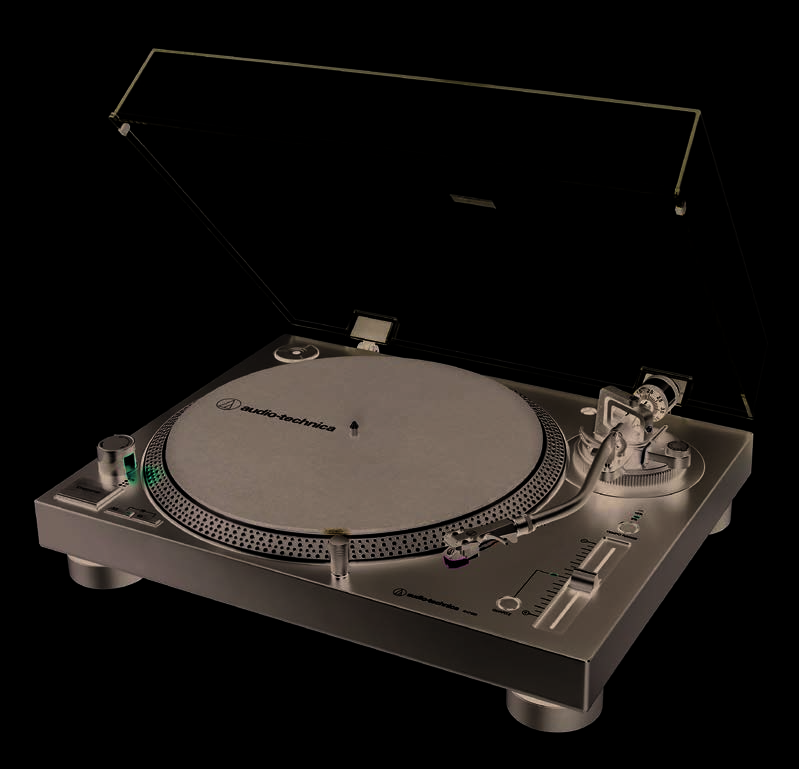
Primary references: Audio-Technica AT-LP120XUSB U.S. product page, AT-LP120XUSB U.S. user manual, and Audio-Technica's official 2024 turntable catalog (page 19 image identification).
Key specifications
Key details at a glance
| Drive | Direct drive |
|---|---|
| 78-RPM play option | Yes |
| Included cartridge | Audio-technica at-vm95e moving-magnet cartridge mounted to at-hs6 detachable universal headshell |
| Built-in phono preamp | Yes |
| Manual tonearm cueing | Yes |
| End-of-record platter stop | No |
| Removable cartridge body or headshell | Yes |
| USB audio capture to computer | Yes |
| Platter | Die-cast aluminum |
| Platter mat | Felt |
| Body width | 17.8 in |
| Body depth | 13.86 in |
| Body height | 5.57 in |
| Published phono output | 4 mV |
Use the exact model’s instructions for operating limits, supplied equipment and version differences.
Sources for this review
Sources for this assessment
Check your phono route before choosing
Check each model's documented input route, arm operation, and body limits. Use the finder to compare supported phono-system arrangements without assuming adjacent models share features.