
Your needs, this model
Does it fit your priorities?
Can the AT-LP5X feed powered speakers without a separate phono box?
Yes, with powered speakers that accept a line input: select LINE so its built-in phono stage feeds them. Use PHONO for a receiver's phono input instead. The deck does not contain speaker amplification.
Explore this need in the finder →Can it connect to an existing receiver PHONO input?
Yes. Select PHONO and connect the RCA plugs and ground lead as the receiver manual requires. The receiver's PHONO stage handles the cartridge-level signal; do not send the deck's LINE output to that input.
Explore this need in the finder →Can I record vinyl to a computer with it?
The manufacturer lists a USB 2.0 output and included cable; its manual specifies selectable 16-bit 44.1 or 48 kHz conversion, requires LINE for USB and expects compatible recording software. Check your computer and software support before treating the connection as a complete archive workflow.
Explore this need in the finder →The AT-LP5X is a manual direct-drive deck for a listener who wants one table to cover ordinary analog playback and a separate computer-recording workflow. Audio-Technica documents three speeds, an integrated switchable phono stage and USB output, but those extras do not automate the tonearm or turn the deck into a complete stereo. You still have to cue and stop records yourself, choose the correct output for each component, and supply speakers and their amplification. This is a research-based assessment of the US manual, manufacturer product page and category record—not a listening test or claim of ownership.
Its useful flexibility is in the connections
The LP5X has two analog output levels. Select PHONO when connecting its RCA cable and ground lead to a compatible receiver or integrated amplifier PHONO input. The receiver provides phono equalization, while its amplifier drives the speakers. Select LINE when the destination is a powered speaker or an amplifier's AUX/line input. The built-in stage is switchable for MM or MC cartridges, but the supplied AT-VM95E is a moving-magnet cartridge, so the stock setup uses the MM position. Cartridge-type and output-level switches solve different problems; choosing both correctly matters.
If you already own a suitable separate phono stage, the PHONO output can feed that component before powered speakers or an amplifier. Avoid sending LINE into a PHONO input, which applies phono equalization twice, or PHONO into an ordinary line input, where the signal will not have the documented line-level route. The manual includes both RCA and ground connections and shows the setup for the receiving component. No speakers or power amplification are built into the turntable.
USB is a separate recording job
Audio-Technica lists a USB 2.0 computer interface with selectable 16-bit conversion at 44.1 or 48 kHz, and the included cable avoids a separate USB-cable purchase for a complete new package. The manual instructs the user to set the phono selector to LINE for USB capture and describes use with compatible recording applications. A computer, recording software, storage and a working file-management routine are still needed; software compatibility and a finished archive are not included guarantees. Treat USB as an additional output path rather than as a replacement for analog connections to speakers.
That combination distinguishes the LP5X from the reviewed AT-LP140XP, which uses a dedicated PHONO-level output and has no built-in stage, and from the older AT-LP7, a belt-drive model whose documented package does not include computer output. Those are practical signal-chain differences, not sound rankings.
Manual means hands-on from start to stop
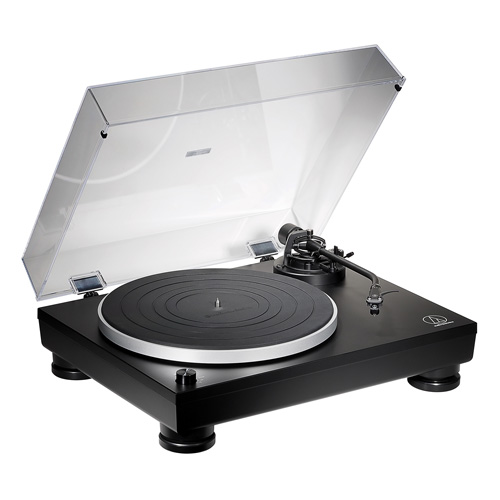
The deck is fully manual. The maker's instructions have the listener release the arm clamp, cue the stylus by hand, use the lift lever as needed and operate the control knob. The manual does not document automatic start, end-of-record arm return or a platter auto-stop. If you want a push-button cycle that places and returns the arm, consider one of the fully automatic models in this library instead. If you prefer choosing the groove yourself, the cue lever and standard counterweight setup make the workflow explicit, but the arm remains your responsibility.
Initial assembly also takes care. Seat the die-cast platter and rubber mat, fit the headshell and counterweight, level the chassis, balance the arm and set the supplied cartridge's tracking force and anti-skate. The manual specifies 2.0 g as the standard force within a 1.8–2.2 g range. A stylus-only change is different from a cartridge swap; changing the cartridge requires checking alignment and resetting the arm rather than just plugging in a new part.
Three speeds do not guarantee a 78 stylus
Platter selection includes 33⅓, 45 and 78 RPM, which gives the LP5X more speed options than a two-speed deck. But the included cartridge is an AT-VM95E with an elliptical LP stylus, not a separately identified 78-specific stylus in the package. If your collection includes shellac discs, confirm the compatible stylus and record-care requirements before playing them. A speed button alone says nothing about stylus size or groove compatibility.
Plan for the body and package
The manual lists the body at 17.72 inches wide, 13.86 inches deep and 6.18 inches high, with a weight of 7.3 kg. These figures describe the body, not the room needed to raise the dust cover, reach the output switches, move the tonearm or bend power, RCA and USB cables. A shelf that is only fractionally larger may not provide a usable setup. The manufacturer lists the cover and hinges, mat, counterweight, detachable headshell and supplied cartridge, 45 adapter, cables and external AC adapter. Check each part on an open-box offer, and verify the adapter's voltage and plug for the exact package.
The official LP5X page describes a J-shaped tonearm, cast-aluminum platter and low-noise motor. Those are design details rather than independent measurements or listening results. The practical fit is stronger: it combines an integrated stage with a computer output, while retaining a manual three-speed routine and an almost 18-inch width.
Who should consider it?
Consider the AT-LP5X if you want manual direct drive, a built-in MM/MC-capable stage, USB capture and three speed choices in one package, and you are willing to make the right connection and handle the arm. Pause if you need automatic cueing, automatic end stop, Bluetooth, speakers, or a shelf narrower than the published width. If 78s are important, research the stylus requirement separately. Before buying, verify the exact AT-LP5X, cartridge and headshell, regional adapter, cables, cover and stylus condition; seller bundles and used packages can differ from the manufacturer's complete new-box list. No current price, stock, ASIN, rating, sound test or hands-on result is implied.
Primary references: Audio-Technica's AT-LP5X US user manual and exact-model product page.
Key specifications
Key details at a glance
| Drive | Direct drive |
|---|---|
| 78-RPM play option | Yes |
| Included cartridge | Audio-technica at-vm95e moving-magnet cartridge on at-hs6 detachable headshell |
| Built-in phono preamp | Yes |
| Manual tonearm cueing | Yes |
| End-of-record platter stop | No |
| Removable cartridge body or headshell | Yes |
| USB audio capture to computer | Yes |
| Platter | Die-cast aluminum |
| Platter mat | Rubber |
| Body width | 17.72 in |
| Body depth | 13.86 in |
| Body height | 6.18 in |
| Published phono output | 4 mV |
Use the exact model’s instructions for operating limits, supplied equipment and version differences.
Sources for this review
Sources for this assessment

Check your phono route before choosing
Check each model's documented input route, arm operation, and body limits. Use the finder to compare supported phono-system arrangements without assuming adjacent models share features.