
Your needs, this model
Does it fit your priorities?
What setup force does Fluance specify for the RT85N's Nagaoka MP-110?
The RT85/RT85N v2.5 manual lists 1.8 g tracking force and 1.8 anti-skate for the included MP-110. Balance the arm as the manual describes before setting the counterweight; do not use the RT85's cartridge data as a substitute.
Explore this need in the finder →Can I assume an Ortofon 2M Blue is interchangeable with the RT85N's MP-110?
No interchangeability is established by this assessment. The RT85N manual publishes different tonearm mass and VTA from the RT85, and Fluance says the MP-110's fit is specific to the RT85N because of VTA. Check current Fluance guidance before any cartridge change.
Can the RT85N use ordinary line-input powered speakers directly?
Not without a phono stage in the signal chain. The RT85N has no built-in phono preamp; connect it to a compatible receiver PHONO input or add an external MM phono stage before ordinary powered-speaker line inputs, using the ground connections prescribed by the manuals.
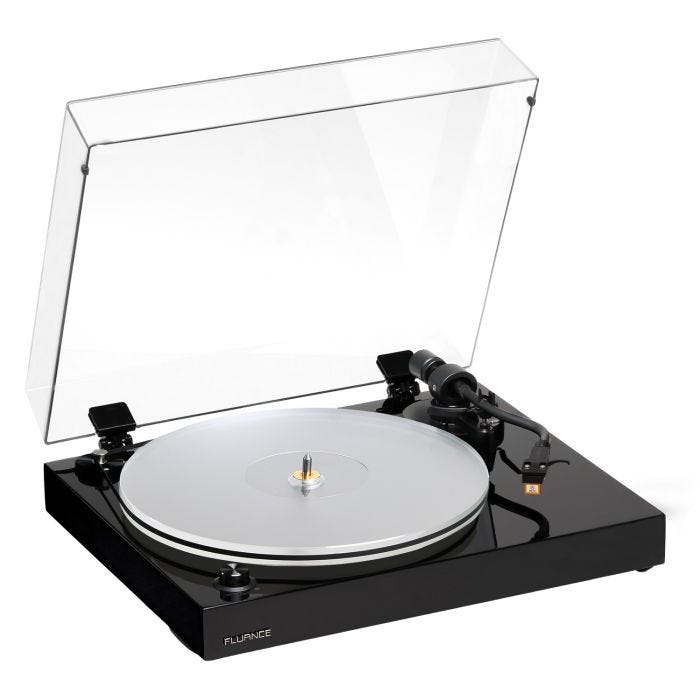
Explore this need in the finder →The Fluance RT85N is a belt-drive turntable supplied with a Nagaoka MP-110 moving-magnet cartridge and an acrylic platter. Although its setup path resembles the RT85, Fluance publishes different tonearm effective mass and vertical tracking angle; the suffix identifies a functional package, not cosmetic trim. The buyer still needs a compatible phono stage or receiver PHONO input. It is manually cued, not a self-operating stereo system.
Identity and the RT85N/RT85 distinction
This review assesses the current US Piano Black RT85N, page item ID RT85NT. Its title, color selector, main product image and user manual identify the Nagaoka MP-110 version. The other observed finish routes are Natural Walnut (RT85NW), Lucky Bamboo (RT85NB) and Piano White (RT85NWH); each page retains its own item identifier and exact photo while documenting the same RT85N functional package. Several pages point to the black URL as canonical, but that is not a reason to erase their distinct finishes.
The RT85's included cartridge is an Ortofon 2M Blue, while the RT85N includes the Nagaoka MP-110. Both use a 3 lb acrylic platter and neither includes a turntable mat. The manual lists effective tonearm masses of 21.1 g for the RT85N and 27.5 g for the RT85; the RT85N's vertical tracking angle is listed as 31 degrees versus 20 for the RT85. It also names JN-P110 as the MP-110 replacement stylus. These data explain why the model suffix matters when checking cartridge compatibility. Fluance's RT85N page says its MP-110 fit is specific to the RT85N because of the different VTA. Do not treat the cartridges as interchangeable or assume a third-party replacement is cleared by the generic half-inch mount alone.
Use a documented phono route
The RT85N has no internal phono preamp. The manual specifies phono-level RCA output, a ground terminal and 5.0 mV output for the MP-110 configuration. Connect it to a compatible receiver or integrated amplifier PHONO input, or put a separate MM phono stage between the turntable and line-input powered speakers. For passive speakers, that line-level stage output then goes to an amplifier or receiver that powers them. The turntable itself supplies neither an amplifier nor speakers. Do not connect the RT85N directly to an ordinary AUX/LINE input and expect a built-in stage, and do not feed an already amplified line output into a PHONO input unless the exact equipment instructions call for it.
Grounding is part of the setup: the manual shows the turntable ground wire connected to the external stage or amplifier. When using a separate stage, follow the component instructions for the stage-to-amplifier or powered-speaker ground as well. Confirm the receiver input accepts a moving-magnet cartridge and check each exact input before connecting. The provided power specification is 100–240 V AC, 50/60 Hz with a 12 V / 500 mA output adapter; use the supplied adapter rather than inferring a replacement from the connector alone.
Set the MP-110 deliberately
Fluance's RT85/RT85N manual gives the MP-110 a recommended tracking force of 1.8 g and an anti-skate setting of 1.8. It lists the cartridge at 6.5 g, the RT85N arm effective mass at 21.1 g, and the JN-P110 stylus as the replacement. The steps require balancing the tonearm before using the indicator ring to set force; the control should not be guessed from the force on the RT85's 2M Blue. Fluance's product FAQ and manual do not state the same general replacement-cartridge mass range: the page says 3.5–7.5 g, while the manual's specifications table lists 5.0–7.5 g. That unresolved difference is a reason to check current manufacturer guidance before changing cartridges, not an invitation to choose the wider number. For the included MP-110, use its model-specific manual setup instructions.
Auto-stop does not automate the arm
The RT85N's belt drive supports 33 1/3 and 45 RPM, and the tonearm is manually started and cued with the lever. The manual's auto-stop feature can stop the platter at the end of a record after roughly 30 seconds, but it may not trigger correctly for every record. That function does not start the arm, lift it or return it. Someone who wants the deck to handle the whole arm cycle should reject this configuration as a match for full automation, even if the platter-stop feature is useful in a manual routine.
Space, platter and tradeoffs
Fluance specifies a 12-inch, 3 lb acrylic platter, a tinted dust cover, an aluminum S-shaped arm and a high-mass MDF plinth. The current product page gives the body as 16.5 inches wide, 14.25 deep and 6 inches high with a ±0.5-inch height tolerance. The v2.5 manual lists 16.5 × 5.5 × 13.75 inches in width-height-depth order. Width matches while the height and depth differ, so use the current page value for a preliminary width/depth screen and check the exact version if furniture fit is tight. A listed body footprint does not include space to route cables, reach the speed control, open or remove the cover, or operate the arm. The RT85N also lacks a built-in phono stage, amplifier or speakers, and the manufacturer says wireless playback is not built in; the product page does not list a USB output. Budget for the rest of the chain separately.
What to verify on the exact offer
Confirm that the listing is an RT85N with the Nagaoka MP-110—not the similarly named RT85/2M Blue—and match the finish/item ID: RT85NT Piano Black, RT85NW Natural Walnut, RT85NB Lucky Bamboo or RT85NWH Piano White. Verify the included cartridge and stylus condition, acrylic platter, counterweight, headshell, belt, 45 adapter, tinted cover, RCA cable, ground lead and correct adapter, especially for used or open-box stock. For a system with powered speakers, include a compatible phono stage unless the speakers themselves have a documented PHONO input. The RT85 assessment is the closer comparison when the 2M Blue package is preferred; neither article makes a sound-quality ranking or claims hands-on testing.
Key specifications
Key details at a glance
| Drive | Belt drive |
|---|---|
| Documented record speeds | 33 1/3 RPM / 45 RPM |
| 78-RPM play option | No |
| Included cartridge | Nagaoka mp-110 moving-magnet; 0.4 × 0.7 mil superfine polished elliptical bonded diamond |
| Built-in phono preamp | No |
| Manual tonearm cueing | Yes |
| End-of-record platter stop | Yes |
| Platter | Acrylic |
| Platter mat | None |
| Body width | 16.5 in |
| Body depth | 14.25 in |
| Body height | 6 in |
| Published phono output | 5 mV |
Use the exact model’s instructions for operating limits, supplied equipment and version differences.
Sources for this review
Sources for this assessment
- RT85N Reference Turntable with Nagaoka MP-110 Cartridge, Acrylic Platter — Black
- Fluance RT85, RT85N Reference High Fidelity Vinyl Turntable User Manual v2.5
- Fluance US standalone turntables catalogue
- What is the difference between Fluance turntables?
- RT85N Reference Turntable with Nagaoka MP-110 Cartridge — Natural Walnut
- RT85N Reference Turntable with Nagaoka MP-110 Cartridge — Bamboo
- RT85N Reference Turntable with Nagaoka MP-110 Cartridge — White
Check your phono route before choosing
Check each model's documented input route, arm operation, and body limits. Use the finder to compare supported phono-system arrangements without assuming adjacent models share features.