
Your needs, this model
Does it fit your priorities?
Can the RT85 use a receiver's PHONO input?
Yes, when the receiver's PHONO input supports the included moving-magnet Ortofon 2M Blue. The manual shows the RCA and ground connection to that input; the receiver supplies the phono stage and speaker amplification. Confirm the exact receiver input and connect the ground lead as its manual requires.
Explore this need in the finder →Can I connect the RT85 to powered speakers with only a LINE input?
Not directly at the correct phono level. The RT85 has no internal phono stage, so use its RCA and ground leads into a compatible external phono preamp, then route the preamp's line output to the powered speakers. Follow both components' grounding instructions.
Explore this need in the finder →Does the RT85 auto-stop make its tonearm automatic?
No. The arm is manually cued, and the manual describes auto-stop as a platter stop with an approximately 30-second delay. Some records may not trigger the stop; the feature does not automatically start, lift or return the arm.
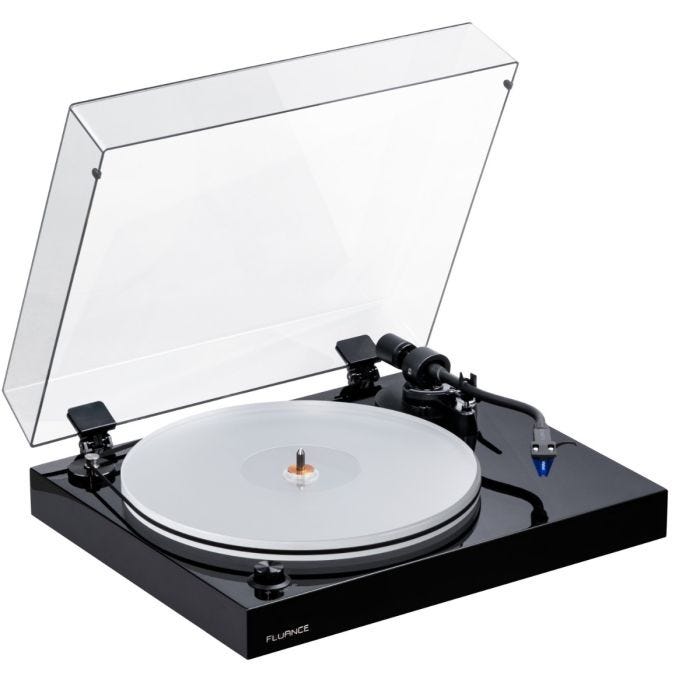
Explore this need in the finder →The Fluance RT85 is a manually cued, belt-drive turntable whose defining current package is an Ortofon 2M Blue cartridge over a heavy acrylic platter. That combination puts it above the RT83 and RT84 in the maker's Reference range, but it does not turn the deck into a complete stereo system: the RT85 has no built-in phono stage, amplifier, speakers, wireless audio or USB output. It makes sense to shortlist only after checking the phono connection and the space around the deck.
Which RT85 is covered here
This assessment is for the current US Piano Black RT85 page, whose product identifier is RT85T and whose package lists the Ortofon 2M Blue and acrylic platter. The Natural Walnut (RT85W), Lucky Bamboo (RT85B) and Piano White (RT85WH) routes are separate finish-only editions. Their official pages show the same RT85 cartridge and platter package, so the review applies to the operating configuration, while each finish retains its own catalog identity and image. Fluance's page canonicals point several of those routes to Walnut; their visible title, finish, item ID and individual images are stronger edition evidence than that shared canonical alone.
The adjacent RT85N is not another name for this deck. It is supplied with a Nagaoka MP-110 and has a different published tonearm effective mass and vertical tracking angle. The RT85's own cartridge and platter should not be assumed for an RT85N offer. Compared with the RT84, the RT85 keeps the 2M Blue cartridge but changes the platter package from aluminum with a rubber mat to acrylic without a separate mat. Those are identifiable component differences, not proof of a better sound; this assessment contains no listening test.
Plan the phono path before buying
Fluance lists the RT85 without an internal phono preamp. Its phono-level RCA outputs and ground terminal can feed a compatible receiver or integrated amplifier PHONO input, or an external phono stage. For powered speakers with ordinary line inputs, the complete route is turntable to phono stage to powered-speaker line input. For passive speakers, use an external phono stage before an amplifier or receiver that drives them. In either route, the stage and speaker amplification are separate components; a deck with RCA sockets is not a line-level source by itself.
The manual describes the ground connection for both routes. With an external stage, it shows the turntable-to-stage ground wire and a second ground lead from the stage to the amplifier or powered speakers when those terminals are provided. Match the exact component manuals rather than assuming a ground wire alone resolves every hum. The included adapter is specified for 100–240 V AC input and 12 V DC / 500 mA output; use the supplied adapter and check the actual package if buying open-box or used.
Manual cueing is separate from the platter stop
The tonearm is not fully automatic. The listener unlocks it, uses the cue lever to lower the stylus, and returns or lifts the arm after playback. Fluance separately documents a defeatable platter auto-stop: when enabled, the platter is intended to stop at the end of a record, with an approximately 30-second delay. The manual warns that record-production differences can prevent some records from triggering the stop. It does not promise automatic start, arm lift or return. A buyer who needs hands-off arm handling should treat this as a manual turntable, not as an automatic deck.
Setup is consequential rather than complicated: assemble and level the platter, fit the belt and pulley cap, balance the arm, set tracking force to the listed 1.8 g for the 2M Blue, and set anti-skate to the same value. The supplied cartridge is a moving-magnet Ortofon 2M Blue; the manual names Stylus 2M Blue as its replacement. Read the current RT85/RT85N manual for the sequence and the exact force table, and avoid transferring force or stylus assumptions from another cartridge.
Platter and footprint: useful specifications, with a mismatch to check
The RT85 is belt-driven by a DC motor with servo control and supports 33 1/3 and 45 RPM. Fluance specifies a 12-inch acrylic platter weighing 3 lb (1.56 kg), no turntable mat, a tinted dust cover, a cueing lever and manual anti-skate adjustment. The current product page lists the body as 6 inches high (±0.5), 16.5 inches wide and 14.25 inches deep. The RT85/RT85N manual instead prints 16.5 × 5.5 × 13.75 inches in width-height-depth order. The width agrees, but the page and manual differ on height and depth. The finder uses the current product-page width/depth; neither measurement includes room for cable bends, controls, cover travel or access to the arm. Confirm the physical revision and leave working clearance rather than treating a close body-fit result as installation approval.
Who should keep comparing
The RT85's package is a reason to compare it if you specifically want the included 2M Blue and acrylic platter and can provide the required phono stage. If the cartridge is the deciding factor, compare it directly with the RT85N, which uses an MP-110 and different arm geometry. If the same 2M Blue with an aluminum platter and rubber mat better matches your package preference, compare the current RT84. If you need a built-in phono stage, a line output, fully automatic tonearm handling or wireless playback from the deck, this RT85 configuration does not document those capabilities. The product page does not list a USB output. Before ordering, verify the exact RT85 finish/item ID, included cartridge, acrylic platter, counterweight, belt, adapter, cables and cover, and check Fluance's current product instructions for that specific offer.
Key specifications
Key details at a glance
| Drive | Belt drive |
|---|---|
| Documented record speeds | 33 1/3 RPM / 45 RPM |
| 78-RPM play option | No |
| Included cartridge | Ortofon 2m blue moving-magnet; 0.3 × 0.7 mil elliptical stylus |
| Built-in phono preamp | No |
| Manual tonearm cueing | Yes |
| End-of-record platter stop | Yes |
| Platter | Acrylic |
| Platter mat | None |
| Body width | 16.5 in |
| Body depth | 14.25 in |
| Body height | 6 in |
| Published phono output | 5.5 mV |
Use the exact model’s instructions for operating limits, supplied equipment and version differences.
Sources for this review
Sources for this assessment
- RT85 Reference Turntable, Ortofon 2M Blue Cartridge, Acrylic Platter — Black
- Fluance RT85, RT85N Reference High Fidelity Vinyl Turntable User Manual v2.5
- Fluance US standalone turntables catalogue
- What is the difference between Fluance turntables?
- How to set up the Reference Turntables from Fluance (RT82, RT83, RT84, RT85)
- RT85 Turntable, Ortofon 2M Blue Cartridge, Acrylic Platter — Natural Walnut
- RT85 Reference Turntable, Ortofon 2M Blue Cartridge, Acrylic Platter — Bamboo
- RT85 Turntable, Ortofon 2M Blue Cartridge, Acrylic Platter — White
Check your phono route before choosing
Check each model's documented input route, arm operation, and body limits. Use the finder to compare supported phono-system arrangements without assuming adjacent models share features.