
Your needs, this model
Does it fit your priorities?
Can the Signature 10 use a receiver PHONO input?
Yes, as an operating plan when the exact seller cartridge is confirmed or you fit a cartridge whose generator type and loading suit the receiver's PHONO input. The deck has no documented built-in stage; the seller pages do not identify a supplied cartridge.
Explore this need in the finder →How much space should I allow for its body?
The listed body is 18.70 inches wide by 13.94 inches deep, so it first enters the supported half-inch caps at 19 inches wide and 14 inches deep. These are body screens only: allow room for the arm, cabling, cover and access.
Explore this need in the finder →Is it fully automatic or equipped with verified auto-stop?
No full-automatic start/end arm routine is documented: the manual describes user-started platter rotation and manual cue-lift operation. Record-end platter auto-stop remains unknown, not confirmed absent.
Explore this need in the finder →Does the exact seller package include a cartridge or a dust cover?
The observed seller pages do not identify a cartridge or confirm a dust cover in the carton. Acoustic Sounds describes Cover it 1 as separately available. Confirm the exact contents before buying; do not infer them from the item photographs.
What the model is—and what the seller page leaves open
The Signature 10 is Pro-Ject’s large, manual belt-drive deck, built around a mass-loaded chassis, a single-pivot 10-inch arm and a heavy damped-aluminum platter. This assessment is based on the maker’s current product page, its product-information sheet and its model-specific manual—not on a listening session or a test unit. Three U.S.-facing Acoustic Sounds pages identify Olive, Black and Mahogany selections of the same Signature 10. They do not document whether a cartridge comes in the exact carton or, if one does, which generator type it uses. That is an important purchase check, not a detail to infer from a photograph or from the manual’s general cartridge instructions.
Acoustic Sounds assigns different seller identifiers to those finishes: T SIG10O, T SIG10B and T SIG10M. These are retailer product numbers, not established Pro-Ject SKUs. The shared model assessment therefore describes the turntable’s documented design, while the cartridge, cover and exact box contents must still be verified for the specific item.
Mass and setup are part of the decision
Pro-Ject lists a 10.4 kg TPE-damped aluminum platter and a separate 405 g record puck inside a 23 kg turntable. Those are substantial handling figures for a component that arrives partly disassembled. The manual describes setting the platter and belt, assembling and balancing the arm, fitting and aligning a cartridge, setting tracking force and anti-skate, adjusting arm height and leveling the deck. Its stated packaged weight is 40 kg, so check delivery, lifting and support arrangements before ordering; the unpacked number alone does not describe the shipping task.
This is not a plug-in-and-play proposition. The long single-pivot arm is adjustable, but those adjustments are only useful when they suit the selected cartridge and the person setting it up. Pro-Ject’s current specification table gives a suitable cartridge mass of 4–10 g. The older manual separately describes counterweight ranges of 4.5–8 g without its additional weight and 7.5–20 g with it. Those descriptions are not identical, so do not treat them as one universal compatibility range. Ask the seller or distributor to confirm the exact arm/counterweight version against the cartridge you plan to use.
Plan for a separate phono stage
No built-in phono preamp is documented. The manual directs the signal cable to a phono preamplifier, which means the downstream equipment matters: a compatible receiver or integrated amplifier can provide the PHONO input, or a separate phono stage can feed powered speakers’ LINE input. For passive speakers, that external phono stage still needs to feed an amplifier, which provides speaker power.
Because the observed seller pages do not identify a supplied cartridge, the route only becomes a complete system after you verify or choose a pickup and match its moving-magnet or moving-coil output and loading to the receiver or separate stage. A tonearm lead ending in RCA plugs is not itself a phono preamp. If you already own the receiver or stage, check its cartridge compatibility before deciding that the Signature 10 is a fit.
Electronic speed control does not make the arm automatic
The maker documents electronic 33/45 RPM selection. The manual still describes pressing a speed button to start rotation and operating the tonearm lift to cue a record. It does not document a fully automatic start-and-return routine. Nor do the inspected maker sources establish an automatic platter stop at record end; that behavior remains unknown here. If hands-off arm movement or a confirmed stop is essential, do not substitute a speed-control feature for that requirement.
Measure the deck and the complete installation
Pro-Ject lists a 475 × 195 × 354 mm body (W × H × D): about 18.70 inches wide and 13.94 inches deep. In the finder’s half-inch steps, the body first clears a 19-inch width cap and a 14-inch depth cap. Those are body screens, not operating-clearance measurements. Add room for the 10-inch arm’s movement, cable bend, access around the controls and whatever cover you use. Acoustic Sounds’ exact item description identifies Cover it 1 as separately available; confirm whether the specific seller package includes a cover or whether you need to source one. Also verify that the intended support can carry the 23 kg deck and any accessories.
Olive, Black and Mahogany: finish-only items
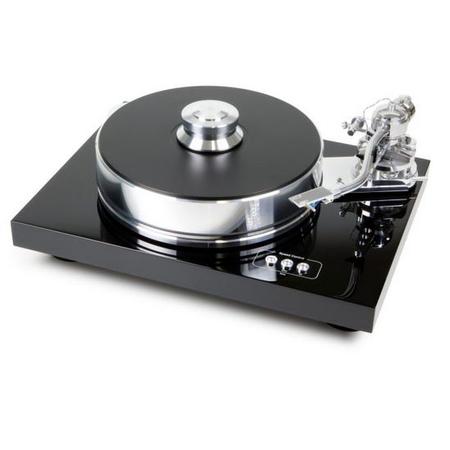
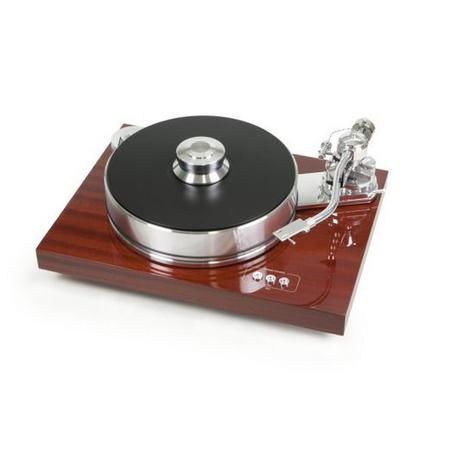
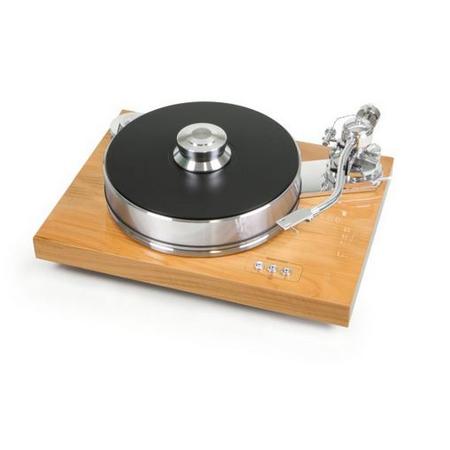
The three observed U.S.-facing seller pages identify finish selections of the Signature 10, not three different arm or phono configurations. The following item-page images show those corresponding finishes; their appearance does not establish cartridge inclusion, cover contents, item condition or availability.
Where it sits beside a more packaged deck
The Signature 10 makes most sense when its mass, manual setup and cartridge choice are part of the appeal. By contrast, Pro-Ject’s Debut Reference 10 assessment covers a much lighter, 6 kg model with a documented pre-adjusted Pick it PRO Balanced MM cartridge, balanced mini-XLR phono output and a separate belt route for 78 RPM. Those facts do not establish that one will sound better; they distinguish the documented setup burden and package. Buyers who want an already identified cartridge and a smaller listed body may find that configuration easier to specify. Buyers choosing the Signature 10 should instead obtain a written answer about the exact cartridge, cover and accessories before treating the seller listing as a complete system.
Bottom line: The Signature 10’s published design is unusually substantial and adjustment-oriented, not compact or automatic. It can be planned around a receiver PHONO input or an external stage, but only after the cartridge in the exact package is confirmed or selected. Measure the installation, account for the deck’s weight, and verify the finish-specific seller carton rather than assuming that all pictured accessories are included.
Key specifications
Key details at a glance
| Drive | Belt drive |
|---|---|
| Built-in phono preamp | No |
| Manual tonearm cueing | Yes |
| Platter | Single-piece aluminum, tpe damped |
| Body width | 18.7 in |
| Body depth | 13.94 in |
| Body height | 7.68 in |
Use the exact model’s instructions for operating limits, supplied equipment and version differences.
Sources for this review
Sources for this assessment
- Pro-Ject Signature 10 official model page
- Pro-Ject Signature 10 Product Information sheet
- Pro-Ject Signature 10 Instructions for Use, revision 2015-07-14
- Acoustic Sounds U.S.-facing Signature 10 Olive item page
- Acoustic Sounds U.S.-facing Signature 10 Black item page
- Acoustic Sounds U.S.-facing Signature 10 Mahogany item page
Check your phono route before choosing
Check each model's documented input route, arm operation, and body limits. Use the finder to compare supported phono-system arrangements without assuming adjacent models share features.