
Your needs, this model
Does it fit your priorities?
Can the VT-E BT R connect to powered speakers without a separate phono preamp?
Yes, use the LINE output to a compatible powered-speaker line input, or use its Bluetooth transmitter with a compatible powered Bluetooth receiver. This does not add amplification for passive speakers.
Explore this need in the finder →Can I use the VT-E BT R with my receiver's PHONO input instead of LINE?
Yes. Use the separate PHONO output and a compatible MM PHONO input. The LINE output already uses the built-in stage and should go to a line input, not PHONO.
Explore this need in the finder →How should I check its footprint and installation before mounting?
The tabletop body is about 16.93 inches wide by 9.65 inches deep; the wall-mounted body is about 16.93 by 5.12 inches wide/deep. The finder uses tabletop depth. Add cable, hardware and access clearance; confirm suitable wall fasteners and keep the screw-on record clamp fitted for vertical playback. Operation remains manual.
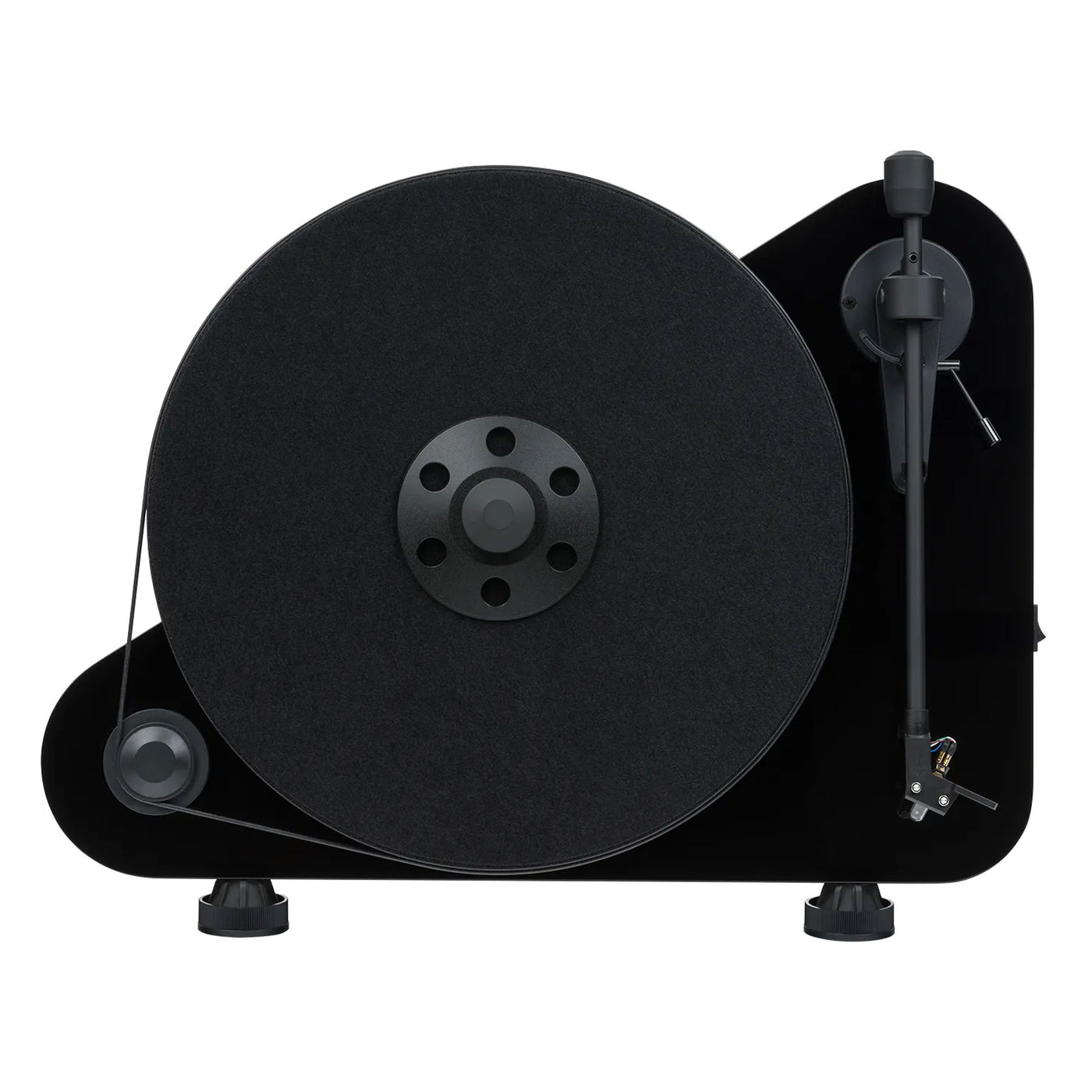
Explore this need in the finder →The Pro-Ject VT-E BT R is the right-hand, Bluetooth-transmitting version of Pro-Ject's vertical VT-E. This is a source-based fit assessment of the manufacturer page, current instructions and U.S. retailer's three color item pages—not a listening test, loaner review, measured result or claim of ownership. The U.S. pages identify black, red and white right-hand versions; the left-hand BT sibling is a separately named configuration on the manufacturer's global page, not a U.S. retail item established by the pages reviewed here.
Two output paths add flexibility, not speakers or amplification
Unlike the standard VT-E R, the BT R has a built-in phono stage, an RCA LINE output, an RCA PHONO output and a Bluetooth transmitter. The manual explains that LINE uses the integrated preamplifier and PHONO is the phono-level route to a compatible external stage or receiver PHONO input. Choose the output that matches the next device; do not send the built-in LINE signal to a receiver's PHONO input. The turntable can transmit audio through Bluetooth and use RCA at the same time, according to Pro-Ject. Its Bluetooth function sends turntable audio out; it is not a Bluetooth input for playing phone music through the deck, and it does not power passive speakers. Pairing depends on the receiving device and surroundings, so check speaker or receiver compatibility rather than assuming every wireless endpoint works.
For powered speakers with a line input, use the built-in stage and the LINE output, or use the Bluetooth transmitter with a compatible receiver. With an amplifier and passive speakers, connect LINE to a normal line input or use the PHONO output with a compatible external stage and the amplifier's line input. The PHONO output also supports a receiver's compatible MM PHONO input. A bare PHONO signal is not suitable for an ordinary AUX/LINE jack. Separate the turntable's phono stage from the downstream power amplifier: the included electronics do not replace speaker amplification.
The vertical hardware still needs a deliberate setup
For tabletop use, Pro-Ject lists a body envelope of 430 × 345 × 245 mm (width, height, depth), roughly 16.93 × 13.58 × 9.65 inches. In the wall-mounted arrangement the published body is 430 × 310 × 130 mm, about 16.93 × 12.20 × 5.12 inches. The finder uses the tabletop depth, so its numeric answer is conservative for someone comparing a wall-mounted installation. Neither configuration's body dimensions represent the required clearance for cables, mounting hardware, hand access or the arm. The retailer's abbreviated dimension line does not describe both placements, so use the maker's orientation-specific values and measure the actual location.
The supplied wall kit does not settle whether a particular wall, anchor or furniture panel is appropriate. The manual explains that wall conversion replaces the rear support and directs the installer to use fasteners suited to the wall. For a tabletop arrangement, install the rear support, platter, belt and record clamp as directed. The manufacturer describes the clamp and tracking mechanism as the way to retain and track a record in a vertical arrangement; use the clamp rather than inferring that the record will stay put without it. The ability to mount vertically is meaningful, but it makes mounting and setup checks part of the ownership routine.
It is still a manual belt-drive turntable
The BT R plays 33 and 45 rpm records, and the manual changes speed by moving the belt to the appropriate motor pulley step. It is not a speed-button system. You start the motor and cue the tonearm yourself; no inspected source documents fully automatic start, arm return or an automatic end-of-side stop. The separate motor switch can stop the platter, but that does not make a record-end stop automatic. This deck suits someone comfortable handling the record and arm, not someone who wants an unattended side.
The maker's specification sheet lists an Ortofon OM cartridge and pre-adjusted tracking force; the exact U.S. retailer pages call the package OM5e. Check the package listing and supplied instructions for the precise cartridge if a seller has changed the item. The current manufacturer page lists Bluetooth 5.2, while its older product-information PDF lists version 3.0. Since that is a real document conflict, this assessment does not promise a Bluetooth version or codec; confirm the exact transmitting version/receiver compatibility if it is a hard requirement. The retailer's spec table also contains an internal inconsistency around the phono-stage field, so the manufacturer output description and current manual are used for signal routing instead.
Black, red and white are separate listed items
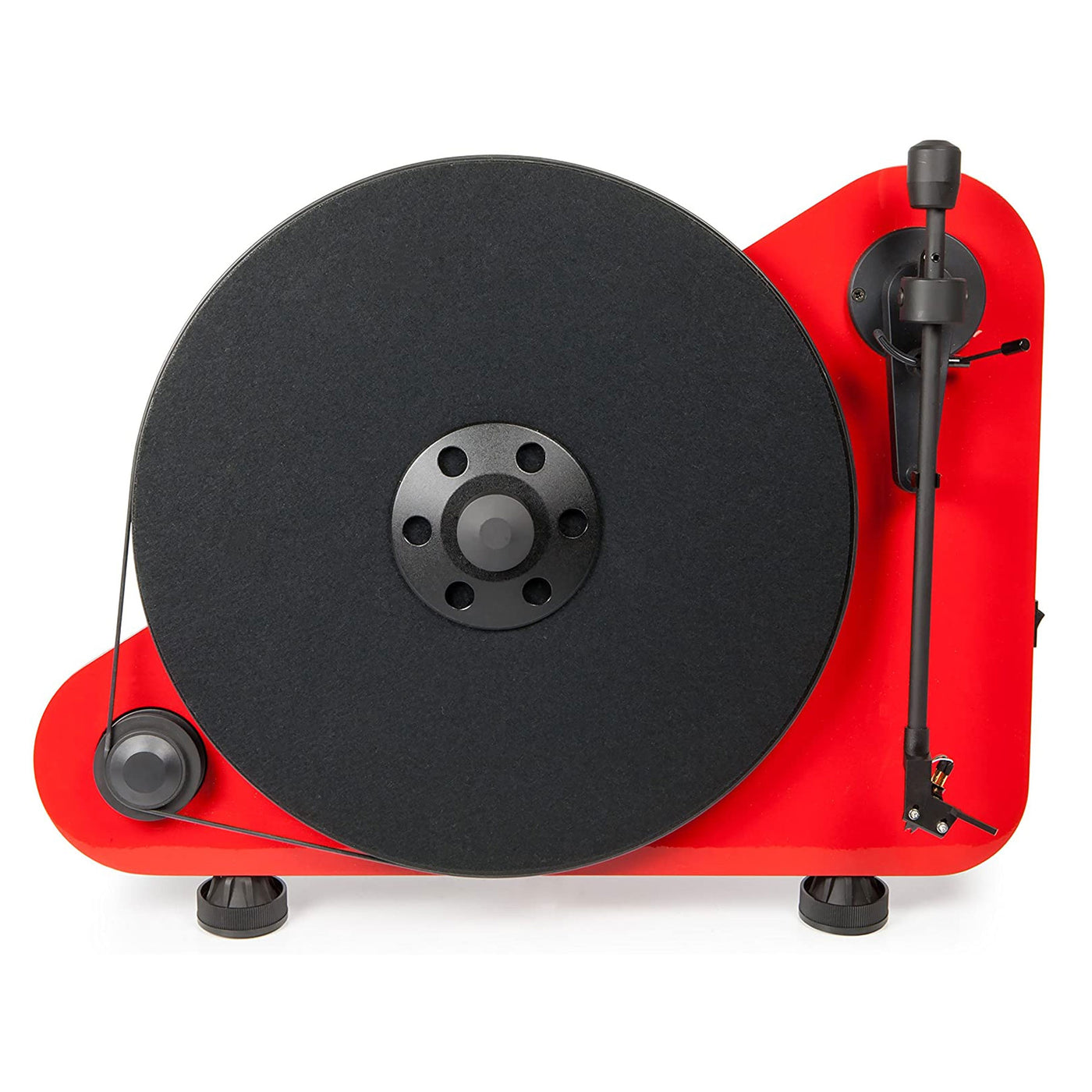
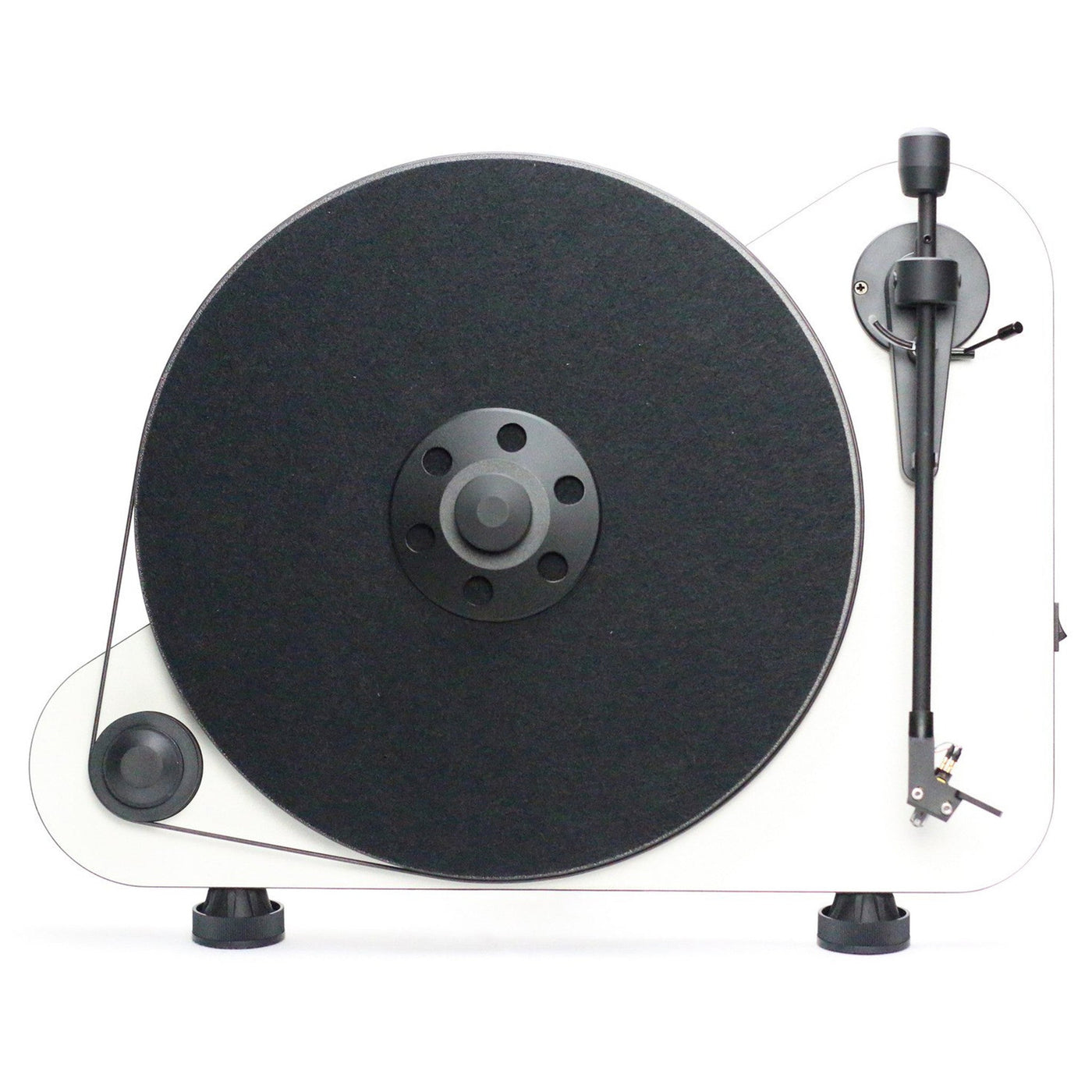
Turntable Lab's U.S.-facing product pages name the VT-E BT R in all three finishes. Their seller SKUs and barcodes are retailer identifiers rather than canonical Pro-Ject model codes. Each image below matches a separately listed chassis finish; none proves the phono circuitry, Bluetooth version, package condition or current availability.
When the BT R makes sense
Consider the BT R when a vertical turntable solves a real installation problem and you need either built-in line-level output or turntable-to-receiver Bluetooth transmission. Prefer the standard VT-E R if your system already has a compatible PHONO input and you do not need the additional transmitter or internal stage. Neither version is a hands-free automatic deck, neither includes speakers, and a wall-mounted body dimension does not certify the wall. Confirm right-hand orientation, exact finish, output choice, receiver/speaker input, suitable anchors, record clamp, supplied adapter and power-supply label before purchase. See the standard VT-E R assessment for the no-stage package and the phono-stage guide before choosing a signal route.
Primary references: Pro-Ject's VT-E BT page, VT-E BT R instructions and VT-E BT product information; Turntable Lab's exact Black, Red and White item records.
Key specifications
Key details at a glance
| Drive | Belt drive |
|---|---|
| Documented record speeds | 33 1/3 RPM / 45 RPM |
| 78-RPM play option | No |
| Included cartridge | Ortofon om5e moving-magnet cartridge (u.s. item page naming; manufacturer page describes an ortofon om cartridge) |
| Built-in phono preamp | Yes |
| Manual tonearm cueing | Yes |
| Bluetooth audio transmission | Yes |
| Platter | 300 mm mdf, 0.8 kg, with felt mat |
| Platter mat | Felt |
| Body width | 16.93 in |
| Body depth | 9.65 in |
| Body height | 13.58 in |
Use the exact model’s instructions for operating limits, supplied equipment and version differences.
Sources for this review
Sources for this assessment
- Pro-Ject VT-E BT official product page
- Pro-Ject VT-E BT product information sheet
- Pro-Ject VT-E BT R instructions, current page revision 2026-10-23
- Pro-Ject official U.S. distributor and Reference Partner directory
- Turntable Lab Pro-Ject mixed U.S.-facing collection, vertical range observation
- Turntable Lab U.S. VT-E BT R Black item page
- Turntable Lab U.S. VT-E BT R Red item page
- Turntable Lab U.S. VT-E BT R White item page
Check your phono route before choosing
Check each model's documented input route, arm operation, and body limits. Use the finder to compare supported phono-system arrangements without assuming adjacent models share features.