
Your needs, this model
Does it fit your priorities?
Can the VT-E R connect directly to powered speakers' ordinary LINE input?
Not in its documented phono-level configuration. Use a compatible MM PHONO input or add an external MM phono stage before the powered speakers' LINE input.
Explore this need in the finder →Can I connect the VT-E R to a receiver's PHONO input?
Yes, if it is a compatible moving-magnet PHONO input. The deck has no built-in stage, so do not connect its phono-level output to AUX/LINE without an external stage.
Explore this need in the finder →How much room does the VT-E R need, and does the supplied wall kit make mounting automatic?
The tabletop body is about 16.93 inches wide and 9.65 inches deep; the wall-mounted body is about 16.93 by 5.12 inches in width and depth. These omit clearance and fasteners. The kit includes the bracket, but the manual says to select anchors suitable for the wall; setup and arm handling remain manual.
Explore this need in the finder →The Pro-Ject VT-E R is a manually operated, right-hand vertical turntable assessed here from its manufacturer documentation and U.S. retailer model records—not from listening, ownership, hands-on setup, or independent measurement. The retailer pages identify black and white right-hand items; the manufacturer also describes left-hand versions and other finishes, but this assessment does not assume that an unlisted orientation or color is the same U.S. retail package.
Its vertical format changes the installation decision
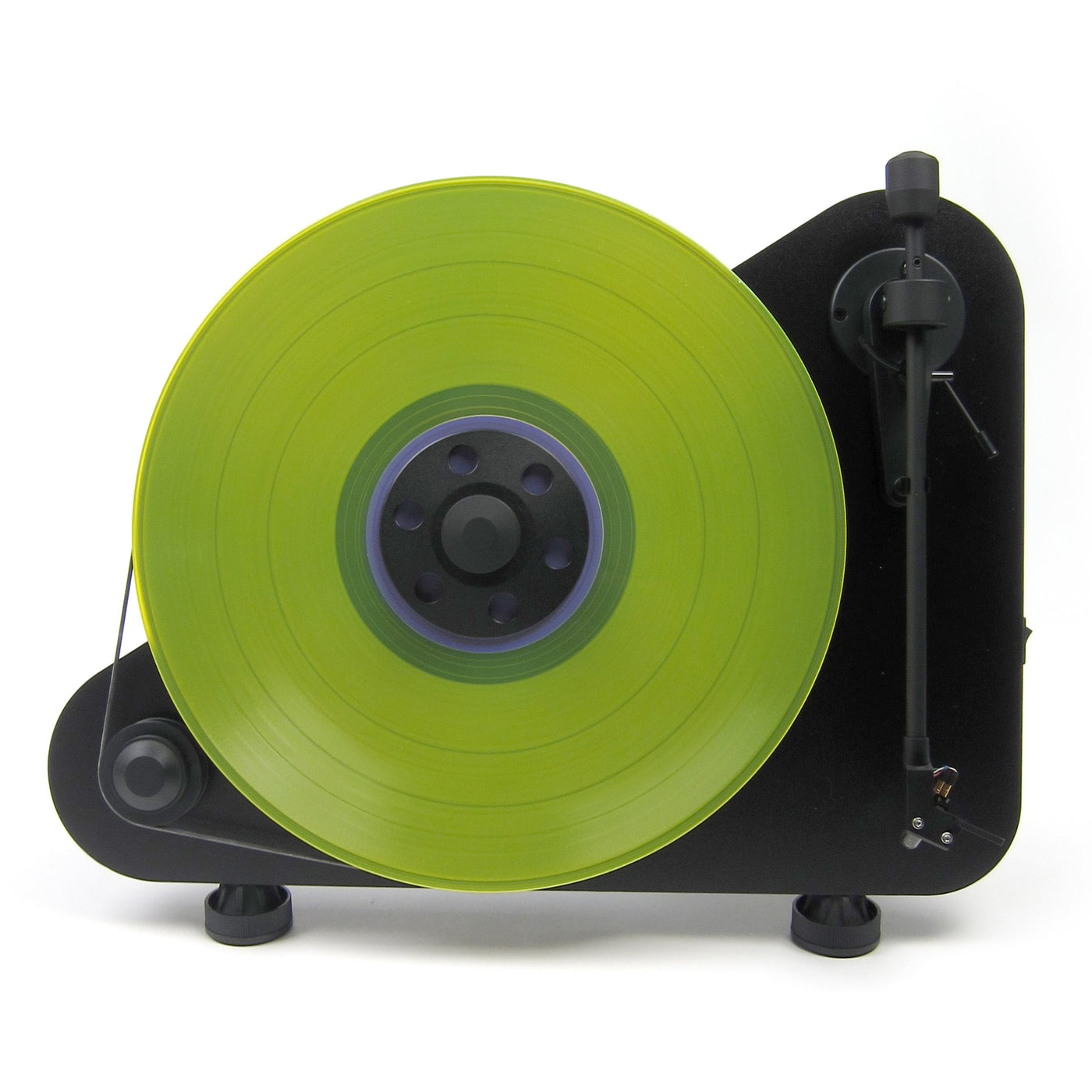
The VT-E R can stand on its supplied rear support or be converted to a wall-mounted arrangement with the included bracket. The two configurations have different published envelopes. On a table, Pro-Ject lists 430 × 345 × 245 mm (width, height, depth); for wall mounting it lists 430 × 310 × 130 mm. Those convert to about 16.93 × 13.58 × 9.65 inches for the tabletop setup and 16.93 × 12.20 × 5.12 inches for the wall-mounted body. The finder compares the tabletop body dimensions only. Neither figure includes access, cables, wall hardware or clearance around the tonearm, and the retailer's listing text uses a different orientation for its dimensions. Measure the exact installation rather than treating a body figure as a fit guarantee.
Wall mounting is a real capability, but it makes the mounting surface and the supplied bracket part of the purchase plan. The manual instructs the user to replace the rear support with the wall holder and use wall fasteners appropriate to the wall type. The supplied kit is not a guarantee that a particular wall, anchor or furniture panel can safely carry the player. If you do not want to drill, the tabletop rear support is the documented alternative. In either setup, use the screw-on record clamp: the manufacturer specifically identifies it as the record-retaining part for vertical playback. That mechanism is not evidence that every disc or installation will be trouble-free, so follow the setup instructions and confirm the intended record format and condition before use.
Plan the phono stage before choosing this package
The VT-E R is the non-Bluetooth, no-built-in-stage member of the vertical pair. Its supplied RCA connection carries a phono-level signal. A compatible moving-magnet PHONO input on a receiver or integrated amplifier is a direct documented route. If your only input is AUX, CD, LINE or a powered speaker's line jack, this model needs an external MM phono stage between the turntable and that line input. Passive speakers also require a power amplifier; neither the turntable nor a phono preamp powers them. Do not feed a bare phono output into a line input and expect the missing equalization and gain to be supplied by the speaker.
The U.S. listing names an Ortofon OM5E cartridge, and the maker's product information and manual describe a pre-mounted, pre-adjusted OM cartridge. The published 18 mN factory setting is not a claim about the actual adjustment of a particular delivered box. Check the exact cartridge and instructions if a seller, previous owner or replacement part changes the supplied setup. The included power supply is also something to verify on the exact package label for the intended mains supply; the product page does not publish a U.S. adapter SKU.
Manual means manual speed and arm handling
This is a belt-drive deck with 33 and 45 rpm playback. The manual's speed-change procedure moves the belt to the other motor-pulley step; it is not an electronic speed button. The listener starts the motor, places and lifts the tonearm, and handles the side. No source examined here documents automatic start, arm return or an end-of-record platter stop. The manual describes a power switch that starts or stops the motor, which should not be mistaken for any of those automatic functions. A listener who wants the machine to manage the side unattended should look elsewhere.
For installation, the written instructions distinguish tabletop assembly from wall conversion and require fitting the platter, belt and clamp after positioning the unit. This is a useful practical tradeoff: the vertical layout can put the records and deck on display while reducing tabletop depth when wall-mounted, but it adds a mounting job and manual interaction. Published speed-variance and wow-and-flutter values are factory specifications, not measurements from this assessment or predictions about a particular sample.
Black, white and red are item finishes, not performance variants
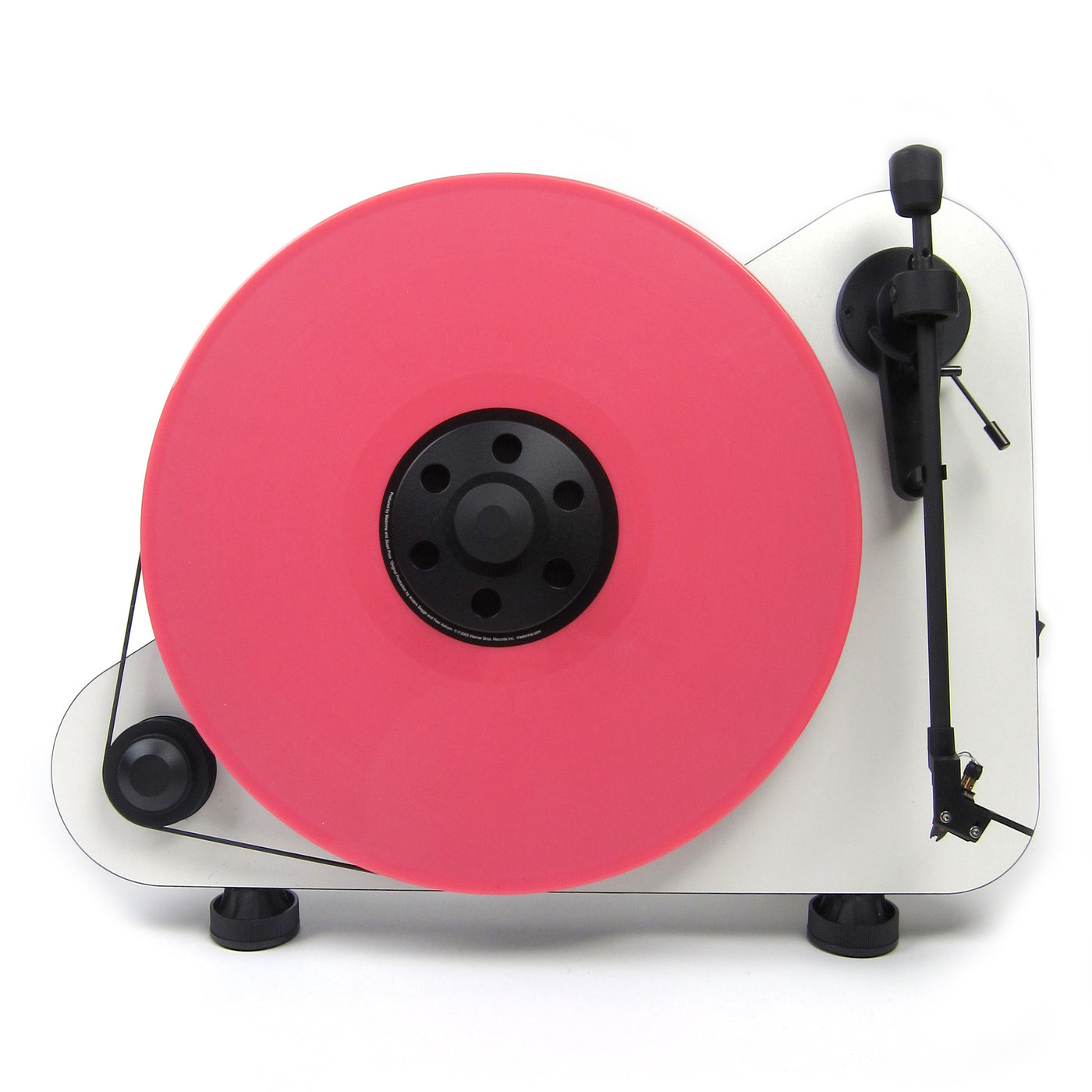
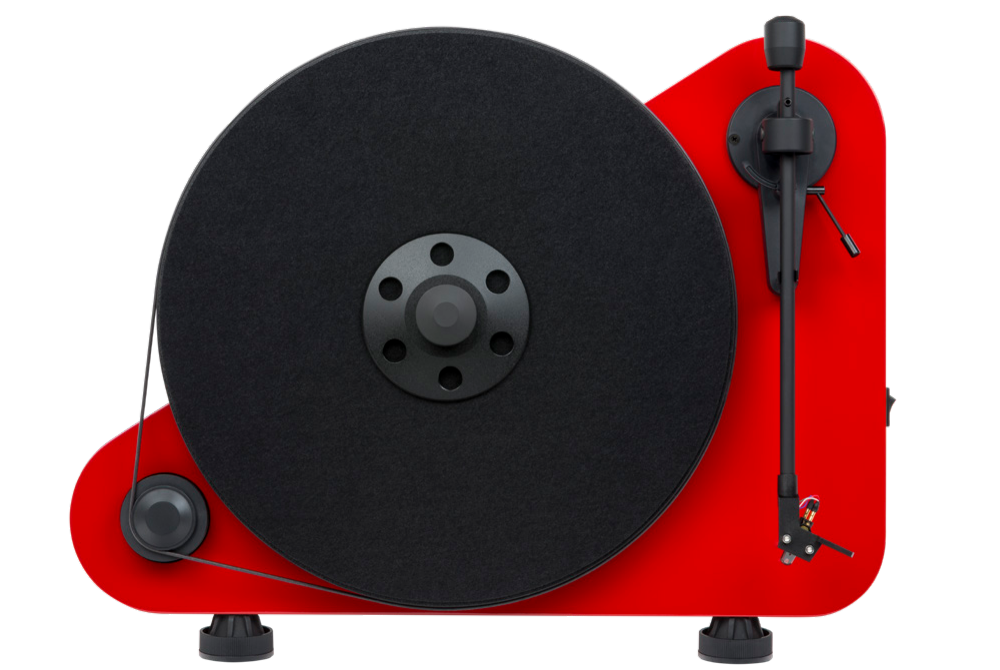
Turntable Lab lists right-hand black and white items. A U.S.-facing George Meyer AV product-family page also lists red, and Pro-Ject's product sheet labels its pictured red configuration VT-E R. I found no distinct U.S. Red item code or current stock statement, so this is finish evidence, not a price or availability claim. The seller SKU and UPC on the Turntable Lab items remain retailer identifiers, not a confirmed Pro-Ject model code. These photos identify the shown chassis finish and hand only; they do not prove cartridge, adapter, condition or current stock.
Who should keep it on the shortlist
The VT-E R is worth considering when a right-hand vertical layout or the wall-mount option solves a specific space or display problem, the system already has a compatible MM PHONO input or will add a separate stage, and manual speed changes and cueing fit the routine. It is a poor match for a line-input-only system that will not add a stage, for someone requiring full automation or verified auto-stop, or for a wall where safe mounting has not been checked. Compare the VT-E BT R if built-in line-level output or Bluetooth transmission is central; those additions do not make it automatic. The related phono-stage guide explains the signal routes, and the finder compares the documented phono and body-size conditions.
Primary and item references: Pro-Ject's VT-E product page, VT-E R instructions and VT-E product information; Turntable Lab's exact Black and White item records; and George Meyer AV's VT-E family listing (no Red item code or stock claim).
Key specifications
Key details at a glance
| Drive | Belt drive |
|---|---|
| Documented record speeds | 33 1/3 RPM / 45 RPM |
| 78-RPM play option | No |
| Included cartridge | Ortofon om5e moving-magnet cartridge |
| Built-in phono preamp | No |
| Manual tonearm cueing | Yes |
| Platter | 300 mm mdf, 0.8 kg, with felt mat |
| Platter mat | Felt |
| Body width | 16.93 in |
| Body depth | 9.65 in |
| Body height | 13.58 in |
Use the exact model’s instructions for operating limits, supplied equipment and version differences.
Sources for this review
Sources for this assessment
- Pro-Ject VT-E official product page
- Pro-Ject VT-E product information sheet
- Pro-Ject VT-E R instructions
- Pro-Ject official U.S. distributor and Reference Partner directory
- Turntable Lab Pro-Ject mixed U.S.-facing collection, vertical range observation
- Turntable Lab U.S. VT-E R Black item page
- Turntable Lab U.S. VT-E R White item page
- George Meyer AV Pro-Ject VT-E U.S.-facing dealer family listing
- Pro-Ject VT-E product information sheet, exact red R image
Check your phono route before choosing
Check each model's documented input route, arm operation, and body limits. Use the finder to compare supported phono-system arrangements without assuming adjacent models share features.