
Your needs, this model
Does it fit your priorities?
Why choose VT-E L instead of VT-E R?
Pro-Ject identifies the L as the left-hand version; its product sheet shows the tonearm assembly on the left side of the platter, while the R layout places it on the right. Confirm the exact VT-E L label and the direction that suits your access before ordering. This is an access/layout difference, not a sourced sound-quality difference.
Can I connect the VT-E L to a receiver's PHONO input?
Yes, if the receiver PHONO input is compatible with the supplied moving-magnet OM5E. Pro-Ject USA’s exact VT-E L manual identifies the fitted cartridge, specifies phono-level signal, directs the user to a compatible PHONO input and says a separate phono stage is needed if the amplifier lacks one. Ordinary LINE inputs are unsuitable; the exact U.S. dealer family page still does not identify a distinct L White retail item, so verify the offered package label and contents.
Explore this need in the finder →Will the published tabletop body fit a 17-inch-wide, 10-inch-deep shelf?
The manufacturer's tabletop body is about 16.93 inches wide by 9.65 inches deep, so it falls within those listed caps on paper. That leaves very little nominal clearance and excludes cable bends, a hand approaching the left-side arm, record handling, wall hardware, or any cover/working room; measure the actual setup before relying on the fit.
Explore this need in the finder →This is a source-based assessment of the white, left-hand Pro-Ject VT-E L. The manufacturer's product sheet labels the left-hand model separately from the red VT-E R, and a U.S.-facing dealer page lists both left/right choices and white among its finishes. Neither source establishes a unique U.S. SKU, a present offer, or the condition of a particular box. I have not listened to, owned, assembled, or measured this turntable.
Choose the arm layout deliberately
The VT-E L is more than a white VT-E R photographed from another angle. Pro-Ject identifies the R as right-handed and the L as left-handed; its product sheet shows the arm assembly on opposite sides of the two platters. That changes where a hand approaches the tonearm and which side of a shelf, wall, or neighboring component must stay accessible. A left-hand arrangement can be useful when the turntable's position makes a right-side arm awkward, but handedness is a layout choice, not a claim about better tracking or sound.
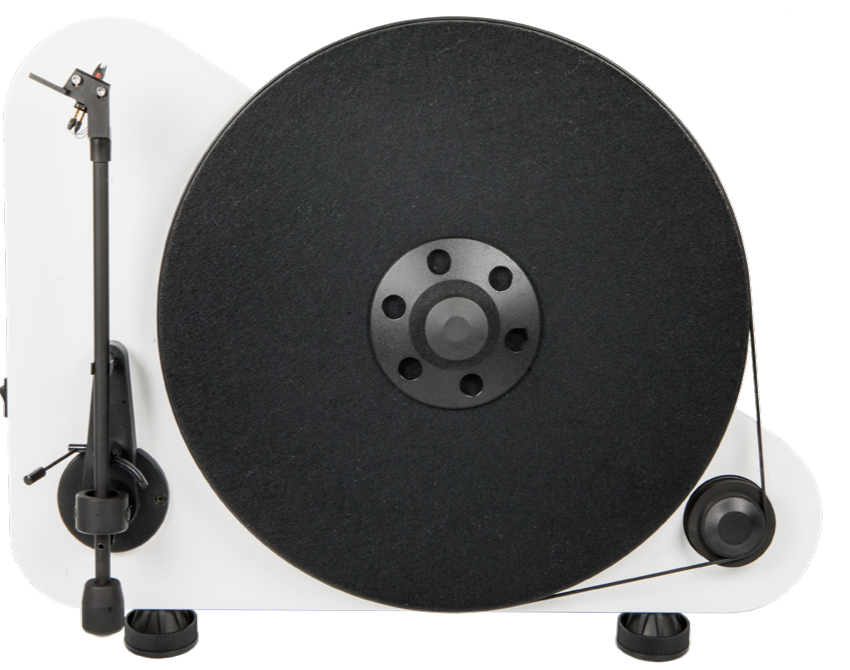
Confirm that the exact item says VT-E L before choosing it. “VT-E” by itself does not tell you which hand, and the seller's general model page does not expose a separate item code or a variant-specific cart image. The comparable VT-E R assessment covers the other arm orientation; its black and white retail items should not be silently substituted for the L.
A vertical deck still needs a planned installation
Pro-Ject describes the VT-E as a belt-drive design that can stand on its rear support or be converted to a wall-mounted arrangement with the included mounting kit. The manufacturer's tabletop body dimensions are 430 × 345 × 245 mm (width × height × depth), or about 16.93 × 13.58 × 9.65 inches. Those are body dimensions, not an operating envelope: allow space for the record, arm movement, cables, support hardware, and a hand approaching the left side.
Do not use the published wall depth as a fit guarantee. The current product page gives a thinner wall-mounted envelope than the older information sheet, which repeats the tabletop dimensions for wall mounting. Pro-Ject USA separately publishes a VT-E L manual (revision 2016.06.30) with distinct desktop and wall-mount installation steps; the product page itself still links the R manual. The L manual does not settle wall clearance, the disputed wall dimensions, or the suitability of an anchor for a particular surface. Use its L-specific instructions, choose wall hardware for the real wall, and keep the tabletop support as an alternative when wall installation is inappropriate.
Check the signal path and the actual cartridge
The U.S.-facing dealer family listing names an Ortofon OM5E, and the official Pro-Ject USA VT-E L manual directly confirms that cartridge is fitted and pre-adjusted. It identifies a captive phono-level tonearm lead, directs the user to a correctly matched PHONO input, says ordinary LINE inputs are unsuitable, and calls for a separate phono stage when the amplifier lacks a suitable phono input. Its OM5E specification lists 4 mV output and a 47 kΩ MM load. The manual supports a compatible moving-magnet PHONO input or a suitable external MM stage before powered-speaker LINE or amplifier LINE/AUX; passive speakers still need a power amplifier. No built-in phono preamp or line-level output is documented.
The exact L manual says to fit the platter, belt, and screw-on record clamp, and requires the clamp for vertical playback. It includes the left-hand desktop and wall-mount steps. Those instructions establish model-specific setup behavior, but a retailer family page still does not prove the condition or exact contents of a particular L White box. Check the item label and package against the manual rather than assuming every listed family option is interchangeable.
Manual operation, with important unknowns
The VT-E L manual directly lists 33 and 45 rpm and instructs the user to move the belt between pulley steps to change speed. It identifies a power switch that starts or stops the motor and a tonearm lift; it does not describe a fully automatic start-and-return sequence. End-of-record arm return and automatic platter stop remain undocumented for this package, so they stay unknown rather than being inferred from manual speed control. If either is essential, choose a model with that exact behavior documented.
The evidence still does not establish a current U.S. offer, unique left-hand retailer code, or variant-specific wall-mounted depth. Pro-Ject USA provides the L manual, but the U.S.-facing dealer family page does not show a separate VT-E L White cart item or confirm the exact box contents. Ask the seller to identify the L White item and verify its label and included parts; use the published L manual for setup, not the R manual linked from the product page.
Who should shortlist it
Consider the VT-E L when the left-hand arm layout is genuinely helpful, a vertical table or verified wall installation suits the room, and the system can accept phono-level output through a compatible MM PHONO input or an added phono stage. It is a poor fit if you need built-in preamplification, line-level output, 78 rpm, unattended automatic operation, or a confirmed current seller offer. Its strongest distinction from the right-hand VT-E is the reversed access layout; the available sources do not support an audio-quality advantage for either hand.
Before buying, confirm the exact L/White identity and that the offered package includes the stated OM5E, adapter, clamp, power supply, and the hardware needed for your chosen tabletop or wall setup. Use Pro-Ject's published VT-E L instructions; the exact retail offer and box contents remain unverified.
Primary and item references: Pro-Ject's VT-E product page and VT-E product information sheet; Pro-Ject USA's separate VT-E L instructions (revision 2016.06.30); the current Pro-Ject product-page link to VT-E R instructions; and George Meyer AV's U.S.-facing Pro-Ject listing, which gives no variant-specific SKU or current stock statement.
Key specifications
Key details at a glance
| Drive | Belt drive |
|---|---|
| Documented record speeds | 33 1/3 RPM / 45 RPM |
| 78-RPM play option | No |
| Included cartridge | Ortofon om5e moving-magnet cartridge per the u.s.-facing dealer family listing; maker product sheet describes a pre-mounted ortofon om cartridge. |
| Built-in phono preamp | No |
| Manual tonearm cueing | Yes |
| Platter | 300 mm mdf, 0.8 kg, with felt mat |
| Platter mat | Felt |
| Body width | 16.93 in |
| Body depth | 9.65 in |
| Body height | 13.58 in |
| Published phono output | 4 mV |
Use the exact model’s instructions for operating limits, supplied equipment and version differences.
Sources for this review
Sources for this assessment
Check your phono route before choosing
Check each model's documented input route, arm operation, and body limits. Use the finder to compare supported phono-system arrangements without assuming adjacent models share features.