
Your needs, this model
Does it fit your priorities?
Can I use the built-in phono stage with powered speakers?
Yes, when you select the Built-in Pluto 2 configuration. The Orbit connection guide says the enabled preamp supplies line level to powered speakers with analog RCA/AUX input or to an amplifier LINE input. The common setup manual says the bypass switch/LED indicates preamp state. Check the exact offer rather than assuming this selectable feature is included.
Explore this need in the finder →Can this Orbit use a receiver PHONO input?
Yes, if you select the no-preamp configuration and the receiver has a compatible PHONO input. The receiver supplies the phono stage and amplification. Do not send an enabled built-in-stage line output to a PHONO input.
Explore this need in the finder →Can it work with line-input powered speakers if I add a separate phono stage?
Yes, select the no-preamp configuration and put a compatible external phono stage between the Orbit RCA output and powered speakers with analog line input. The speaker must provide its own amplifier.
Explore this need in the finder →Can it work with passive speakers and a separate stage?
Yes. With no built-in stage selected, connect the Orbit to a compatible external phono stage and then feed that stage’s line output to an amplifier/receiver line input driving passive speakers. With the built-in preamp option enabled, use the amplifier line input instead of PHONO.
Explore this need in the finder →Is the Orbit fully automatic or equipped with record-end auto-stop?
No fully automatic arm sequence is documented; the manual describes belt installation and manual speed changes, and the product page treats the cue lever as a manual aid. A record-end platter auto-stop is not specified, so the model should not be chosen to satisfy a required auto-stop feature.
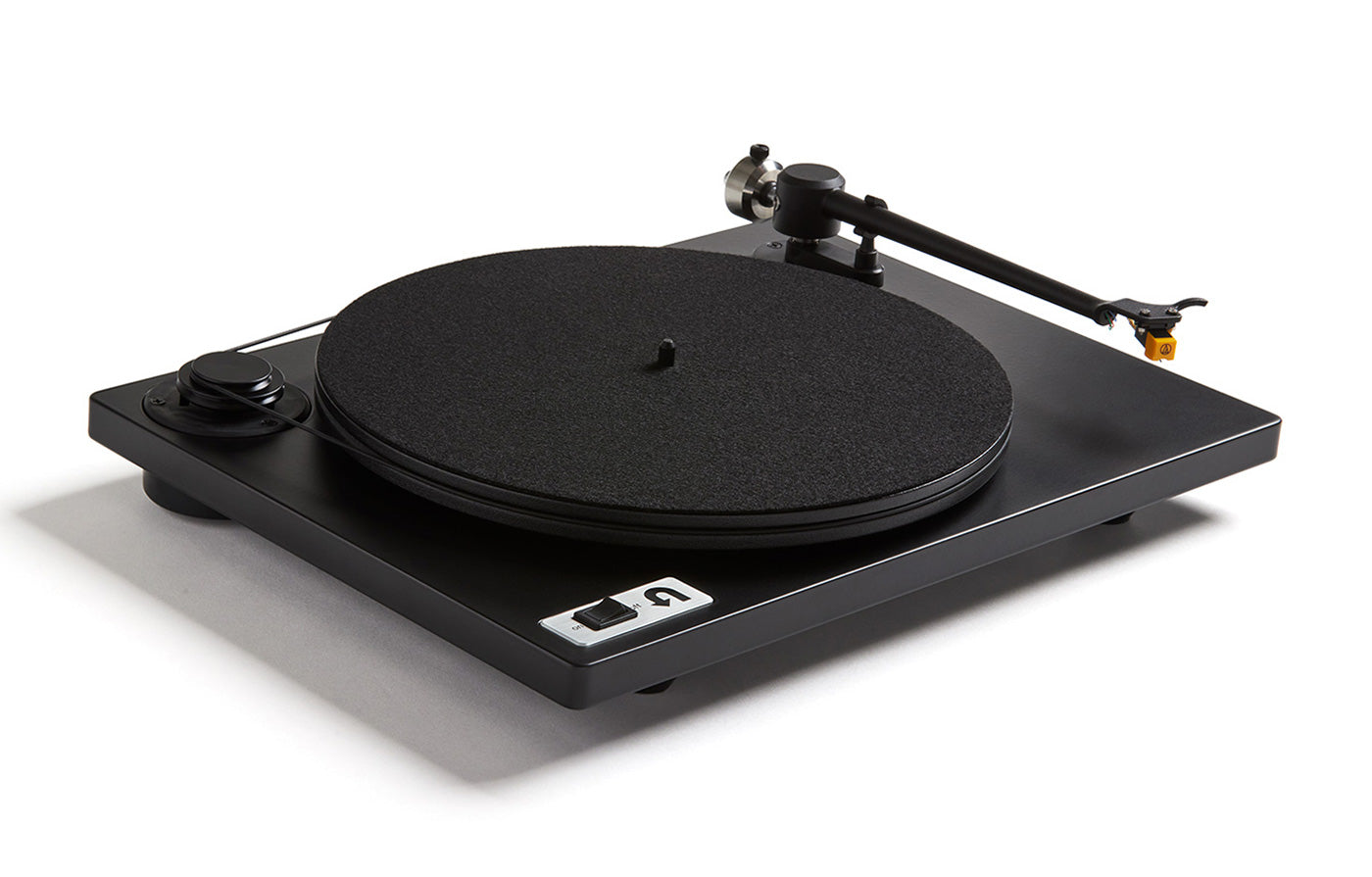
Explore this need in the finder →The current U-Turn Orbit Basic is a deliberately simple two-speed belt-drive turntable, but “Basic” does not mean every buyer receives the same set of options. Its current product page describes an OA3 magnesium tonearm, Audio-Technica AT91B moving-magnet cartridge with a conical stylus, and a grooved MDF platter. The buyer can select no built-in phono stage or the optional Pluto 2 stage; the cue lever is also optional. This is a source-based assessment of the current U.S. offer, not a listening test, measurement session or ownership report.
The package is defined by the platter and cartridge
Orbit Basic is the least feature-rich member of the three current Orbit decks reviewed here, and the distinctions are physical rather than vague price-tier language. Its platter is MDF, while the current Plus and Special pages specify acrylic. The supplied AT91B uses a conical diamond stylus, whereas Plus supplies an elliptical Ortofon OM5E and Special an elliptical Ortofon 2M Red. For an entry system where initial cost and a conventional cartridge replacement path matter more than a higher-tier stock stylus, Basic’s package can make sense. A listener comparing the three should decide whether that cartridge and platter difference is worth stepping up, rather than assume all Orbit versions sound or perform alike based only on the shared plinth and tonearm family.
U-Turn lists 33⅓ and 45 RPM playback. Basic changes speed by moving the belt between pulley positions, so selecting a different record speed is a hands-on setup step rather than a twist of a control knob. The company publishes a 16.75 × 12.5 × 4.25-inch body, RCA output, a 115 V / 60 Hz input, and headline wow/flutter, signal-to-noise and rumble figures. These remain manufacturer-published specifications, not independently verified bench readings. Reserve room for the dust cover, cables and arm movement beyond the bare body dimensions.
Choose the phono path when ordering
The preamp selector materially changes how the deck should be connected. With the None option, the turntable needs a receiver or integrated amplifier with a suitable PHONO input, or an external phono stage. For powered speakers that only offer an ordinary analog line input, the route is Basic → external phono stage → speaker line input. For passive speakers without a receiver PHONO input, the separate phono stage feeds the amplifier’s LINE/AUX input, and that amplifier drives the speakers. The U-Turn connection guide describes these alternatives and the shared setup manual documents the built-in preamp bypass when equipped.
The optional built-in Pluto 2 configuration simplifies a line-level system: enable the stage and connect its RCA output to powered speakers with analog input or an amplifier/receiver LINE input. Do not send that already-equalized line signal into a receiver’s PHONO input. The current page shows both preamp choices, so verify which one is included on the actual offer. “Orbit Basic” alone does not establish that the built-in stage was selected. A complete speaker system is also not included in the standalone deck package.
Manual setup is part of the decision
Basic is not fully automatic. Its manual describes assembling the platter, fitting the belt, leveling the deck and moving the belt to change speed; it does not document automatic start, arm lift or return. The product page offers a cue lever as a separate option; a lever helps lower and raise the stylus but does not turn the arm into an automatic mechanism. The available setup guide does not document a record-end platter stop, and the two listed speeds do not include 78 RPM. If automatic end-of-side handling or shellac playback is essential, choose a model with those exact capabilities supported rather than reading them into a general turntable description.
Setup is not entirely hands-off even before playing a record. Confirm the tonearm is balanced and the supplied cartridge is properly installed as directed by the maker; keep the stylus guard on during assembly and remove it before playback. If a cue lever is important to you, check that the option appears in the order configuration rather than assuming it is in every Basic box. The published included-parts list names the adapter, RCA cable, dust cover and felt mat. For an open-box or second-hand example, inspect the platter, belt, counterweight, cartridge/stylus, cover hinges and power adapter, and ask whether the optional stage or cue lever is actually fitted.
Where it sits in the current Orbit line
The current Orbit Plus retains manual belt changes but pairs an acrylic platter with the OM5E elliptical cartridge. The Orbit Special uses an acrylic platter and 2M Red, includes the cue lever and changes 33/45 electronically. Those are meaningful differences for buyers who prefer a different stylus profile, value a built-in cue aid or want not to move the belt when changing record speed. None of the three has documented automatic arm handling or an advertised record-end stop in the examined current sources.
Orbit Basic is best treated as a configurable manual deck rather than a ready-made all-in-one system. It can be a reasonable candidate when its conical AT91B, MDF platter, simple belt-change routine and chosen phono route match the rest of the setup. Before buying, confirm the exact preamp and cue-lever options, the actual stylus condition, analog inputs on the amplifier or powered speakers, U.S. power adapter, included parts and usable shelf clearance. No price, current stock, listening preference or real-world performance claim is made here.
Primary references: U-Turn Orbit Basic product page, the Orbit setup guide, and U-Turn’s turntable connection guide.
Key specifications
Key details at a glance
| Drive | Belt drive |
|---|---|
| Documented record speeds | 33 1/3 RPM / 45 RPM |
| 78-RPM play option | No |
| Included cartridge | Audio-technica at91b moving-magnet cartridge with conical diamond stylus |
| Built-in phono preamp | Yes |
| Manual tonearm cueing | Yes |
| Platter | Mdf |
| Platter mat | Felt |
| Body width | 16.75 in |
| Body depth | 12.5 in |
| Body height | 4.25 in |
Use the exact model’s instructions for operating limits, supplied equipment and version differences.
Sources for this review
Sources for this assessment
Check your phono route before choosing
Check each model's documented input route, arm operation, and body limits. Use the finder to compare supported phono-system arrangements without assuming adjacent models share features.