
Your needs, this model
Does it fit your priorities?
Can I connect the AT-LPW30BK to powered speakers without a separate phono box?
Yes, if the speakers have a line input: select LINE on the built-in phono stage and connect RCA. Select PHONO instead for a compatible receiver PHONO input; the speakers or receiver still provide amplification.
Explore this need in the finder →What stylus is supplied, and what can replace it?
The exact BK manual lists the AT-VM95C with a bonded 0.6 mil conical stylus on an AT-HS4 headshell. Audio-Technica lists VM95-family replacement stylus compatibility; a full cartridge change still needs alignment and arm setup.
Explore this need in the finder →Will the arm lift and stop at the end of a record?
The manual describes manual cueing and returning the arm, then turning the knob to STOP. It does not document automatic arm return or platter auto-stop, so plan to handle each side yourself.
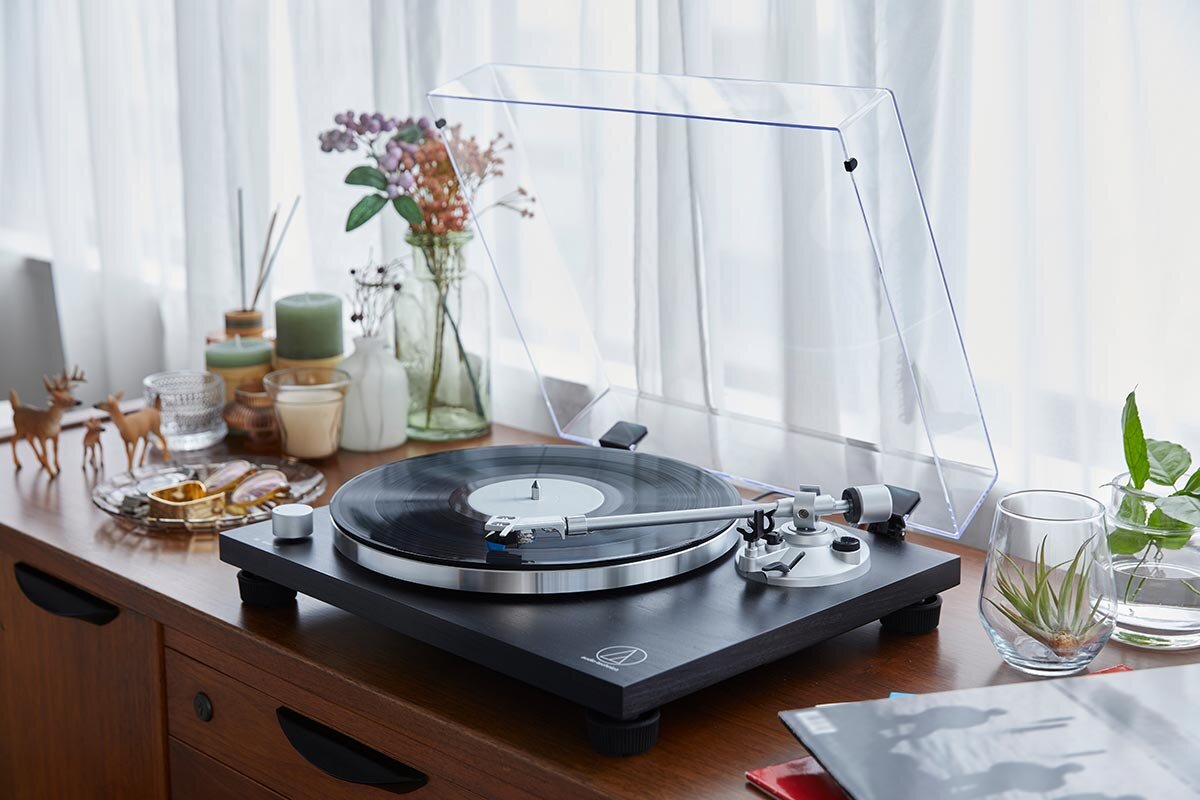
Explore this need in the finder →The AT-LPW30 is a two-speed, fully manual belt-drive turntable for someone who wants a traditional RCA system with a built-in phono stage and a replaceable cartridge, but does not want automatic arm handling or wireless features. The current U.S. category identifies an AT-LPW30 card; the U.S. manufacturer catalog resolves the black order code as AT-LPW30BKR / AT-LPW30BK. Its model-specific English manual lists an AT-VM95C cartridge with a conical stylus. This is a document-based assessment, not a listening test or claim of ownership.
Manual operation is part of the decision
The drive belt links a DC-servo motor to an aluminum platter, and the listed speeds are 33⅓ and 45 RPM. The manual describes the listener moving the arm onto a record, using the cueing lift, and returning the arm before turning the control to STOP. It does not describe automatic start, arm lift, return or platter stop. Choose it only if that hands-on routine suits you; the word “manual” is not a minor setup detail. There is also no 78 RPM selection in the listed specification, so this is not a three-speed choice for someone with 78s.
The stock cartridge is the moving-magnet AT-VM95C on a standard half-inch AT-HS4 headshell. The C suffix identifies a bonded conical stylus, not the elliptical stylus on the AT-VM95E supplied with the LPW40WN and several LPW50 models. The manufacturer lists compatibility with the VM95 replacement-stylus family. That creates a clear future stylus path without making a new stylus a promise of a particular sound. A cartridge swap is more involved than a stylus replacement: the buyer must be prepared to check alignment, balance the arm, set tracking force and anti-skate.
One switch covers two wired phono routes
The LPW30 includes a selectable phono equalizer and detachable RCA output. Set the selector to PHONO when sending the low-level cartridge signal to a compatible receiver PHONO input; connect the ground lead as the receiver instructions require. Select LINE when the destination is a normal AUX or line input, including powered speakers with a line-level input. A separate phono stage can also be placed after PHONO output. These are alternate routings, not components built into the deck: it contains no speakers or amplifier for passive speakers. Matching LINE to PHONO, or PHONO to a plain line input, can produce an unsuitable level, so check both devices before connecting them.
Published output is 4.0 mV PHONO and 200 mV LINE, with 35 dB nominal RIAA gain. These are manufacturer specifications, not measurements from this review. The turntable has no documented Bluetooth output or USB capture, so it will not directly pair with wireless headphones or digitize records over USB. If either connection is important, compare with the AT-LPW50BT-RW for Bluetooth or a model that explicitly lists USB.
Assembly and physical placement
The listed box contents include the platter, belt, rubber mat, counterweight, headshell with cartridge, dust cover and hinges, 45-RPM adapter, RCA lead and external AC adapter. The manual still calls for initial assembly and adjustment: seat the platter, fit the belt without twisting it, place the mat, attach the counterweight, level the turntable and set the supplied cartridge’s 2.0 g standard tracking force. A used or open-box offer needs a parts check, especially the belt, counterweight, headshell/cartridge, cover hinges and the correct power adapter. Missing or damaged accessories should not be inferred from a seller’s generic product photo.
Audio-Technica lists a body footprint of 16.53 inches wide by 13.38 inches deep and a height of 4.60 inches; its weight is 3.90 kg without the dust cover. Measure the usable shelf, then allow more room for cable bends, control access, arm movement and lifting or removing the hinged cover. The body numbers do not define the complete operating space, and a turntable should sit level and away from strong vibration, including speaker vibration.
Where it differs from nearby LPW models
The LPW30's aluminum straight arm and conical VM95C make a different supplied package from the LPW40WN: the latter has a carbon-fiber arm, speed-sensor motor and VM95E elliptical cartridge. The LPW40WN retains manual cueing, two speeds and a selectable analog phono stage, so its relevant distinction is the documented configuration rather than an assumed sound ranking. The piano-black AT-LPW50PB also supplies a VM95E but adds the 30 mm piano-black plinth and is heavier; the rosewood AT-LPW50BT-RW adds Bluetooth. None should be treated as a color-only LPW30 option.
Consider the LPW30 when its manual workflow, conical stock stylus, analog RCA connections and built-in selectable stage fit your setup. Pass if you require automatic end handling, a third speed, Bluetooth, USB capture or included speaker amplification. Manufacturer sources disagree in veneer wording: the U.S. catalog describes teak-simulated veneer while Audio-Technica’s exact BK product page describes black wood. Both identify the same black LPW30BK product; the review uses the confirmed black finish and exact model image, and does not make a materials-grade claim. No sound result, reliability test, price, stock status or personal use is implied.
Primary references: Audio-Technica U.S. turntable catalog card, Audio-Technica U.S. turntable catalog (AT-LPW30BKR), Audio-Technica AT-LPW30BK English manual, and Audio-Technica AT-LPW30 BK model page.
Key specifications
Key details at a glance
| Drive | Belt drive |
|---|---|
| 78-RPM play option | No |
| Included cartridge | Audio-technica at-vm95c moving-magnet cartridge on at-hs4 headshell |
| Built-in phono preamp | Yes |
| Manual tonearm cueing | Yes |
| End-of-record platter stop | No |
| Removable cartridge body or headshell | Yes |
| Platter | Die-cast aluminum |
| Platter mat | Rubber |
| Body width | 16.53 in |
| Body depth | 13.38 in |
| Body height | 4.6 in |
| Published phono output | 4 mV |
Use the exact model’s instructions for operating limits, supplied equipment and version differences.
Sources for this review
Sources for this assessment

Check your phono route before choosing
Check each model's documented input route, arm operation, and body limits. Use the finder to compare supported phono-system arrangements without assuming adjacent models share features.