
Your needs, this model
Does it fit your priorities?
Can I connect the LPW50PB to an existing receiver PHONO input?
Yes, if the input is suitable for its moving-magnet cartridge: set the selector to PHONO and connect RCA and ground. Use LINE for AUX/line inputs or powered speakers with a line input.
Explore this need in the finder →Does the piano-black AT-LPW50PB have Bluetooth?
The reviewed U.S. manual and page document selectable wired RCA output and do not list Bluetooth. The separate AT-LPW50BT-RW is the wireless model; do not assume that capability from shared LPW50 numbering.
Explore this need in the finder →How much room should I allow?
Audio-Technica lists a 16.54 by 13.39 by 4.96 inch body. Add clearance for RCA and power cables, arm travel, controls and dust-cover access; its listed dimensions are not an operating-clearance guarantee.
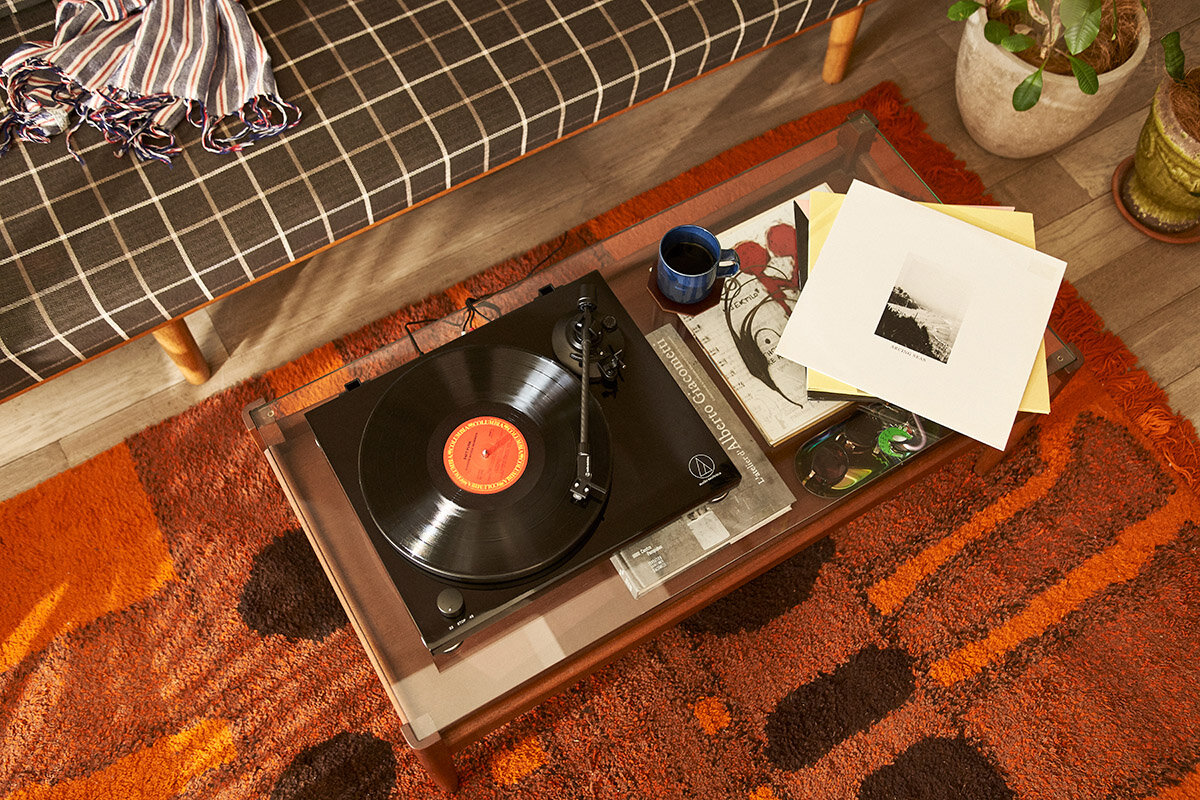
Explore this need in the finder →The AT-LPW50PB is a piano-black, fully manual, two-speed belt-drive turntable with a 30 mm MDF plinth, carbon-fiber arm, AT-VM95E cartridge and selectable phono preamp. It is the wired analog member of the LPW50 pair considered here: the rosewood LPW50BT-RW adds a Bluetooth output, while the PB configuration does not list one. This review weighs the published setup and system differences; no listening test, measurement or ownership is claimed.
A manual deck with a distinct chassis package
The platter is belt-driven by a DC-servo motor with speed-sensor control, and the manufacturer lists 33⅓ and 45 RPM. The manual still requires the user to set the speed, lower the arm to the groove, lift and return it, and turn the control to stop. The product does not document fully automatic start, end lift/return or platter auto-stop. It also does not list 78 RPM. Treat the sensor as a documented feature, not proof of a measured speed advantage.
The body is a 30 mm MDF plinth with a piano-black finish, aluminum die-cast platter and rubber mat. The stock cartridge is AT-VM95E BK on an AT-HS4 BK headshell, with a bonded elliptical stylus. That makes the supplied cartridge comparable by family to the LPW40WN and LPW50BT-RW, but the PB has its own exact package and image. The manufacturer identifies VM95-series replacement-stylus compatibility. A stylus upgrade does not require the same work as a cartridge change; for a new cartridge, plan to align it and set arm balance, tracking force and anti-skate according to the cartridge instructions.
Wired system routing is selectable
The rear phono selector changes the RCA output. Set PHONO when a compatible receiver or integrated amplifier has a PHONO input; use LINE for AUX/line inputs or powered speakers with line inputs. The manual lists a 4.0 mV nominal phono signal and 200 mV nominal line output, with 35 dB nominal RIAA gain. These are manufacturer values and do not turn the deck into a complete sound system. It has no speaker drivers and no power amp for passive speakers. If an external phono stage is part of the system, select PHONO and route the turntable through that stage before an amplifier or powered-speaker line input.
The LPW50PB has analog RCA connections but no documented Bluetooth or USB output. It therefore avoids the pairing task of the BT model but cannot send records wirelessly to Bluetooth headphones or a speaker. If wireless listening is essential, compare the AT-LPW50BT-RW and check its codec/device support. If digital archiving is the goal, choose a model whose manufacturer documents USB audio capture; the LPW50PB's included accessories do not provide that path.
Allow for the body and the setup sequence
Audio-Technica lists 16.54 inches wide, 13.39 inches deep and 4.96 inches high, at 5.56 kg. That is taller and heavier than the LPW40WN, although the bare listed width and depth are nearly identical. Measure the surface and add clearance for cable bends, control access, arm travel and the cover. Keep the deck level and away from high vibration; the body dimensions are not a promise that a tightly fitted shelf gives adequate room to operate it.
The box list includes the deck, removable cover and hinges, platter with belt, mat, counterweight, headshell/cartridge, 45 adapter, RCA cable and external 12 V adapter. The manual's first-use steps still involve assembling the platter and belt, leveling, balancing the arm and setting the supplied cartridge's 2.0 g standard tracking force. Check a used listing for a stylus protector and undamaged stylus, correct adapter, belt, counterweight and cover hinges. A seller's generic photograph is not enough to establish that the exact AT-LPW50PB package is complete.
Compare by the actual task, not the family number
The AT-LPW40WN provides the same stock VM95E family, switchable stage and two speeds in a lighter walnut-look body; the PB instead emphasizes the piano-black thicker plinth and its specified height/weight. The AT-LPW30 comes with a conical VM95C and an aluminum arm. These differences matter to a buyer choosing a supplied stylus and chassis, not as proof of a sonic winner. The LPW50BT-RW keeps the LPW50's manual wired workflow and adds Bluetooth; its wireless link is a separate route, not an automatic tonearm feature.
Consider the LPW50PB if you want manual handling, two speeds, an adjustable cartridge package, selectable analog output and a piano-black plinth, with no requirement for wireless or USB. Pass if you need automatic end handling, Bluetooth, 78 RPM, computer capture or built-in speakers. The review does not claim listening results, durability, vibration measurements, a particular retail price, current stock or an included amplifier.
Primary references: Audio-Technica U.S. turntable catalog card, Audio-Technica AT-LPW50PB U.S. manual, and Audio-Technica AT-LPW50PB product page.
Key specifications
Key details at a glance
| Drive | Belt drive |
|---|---|
| 78-RPM play option | No |
| Included cartridge | Audio-technica at-vm95e bk moving-magnet cartridge with at-hs4 bk headshell |
| Built-in phono preamp | Yes |
| Manual tonearm cueing | Yes |
| End-of-record platter stop | No |
| Removable cartridge body or headshell | Yes |
| Platter | Die-cast aluminum |
| Platter mat | Rubber |
| Body width | 16.54 in |
| Body depth | 13.39 in |
| Body height | 4.96 in |
| Published phono output | 4 mV |
Use the exact model’s instructions for operating limits, supplied equipment and version differences.
Sources for this review
Sources for this assessment

Check your phono route before choosing
Check each model's documented input route, arm operation, and body limits. Use the finder to compare supported phono-system arrangements without assuming adjacent models share features.