
Your needs, this model
Does it fit your priorities?
Does the AT-LPW40WN need an external phono preamp?
Not necessarily: it has a switchable built-in phono stage. Select LINE for an AUX/line input or powered speakers with line input, and PHONO for a compatible receiver PHONO input or an external stage.
Explore this need in the finder →Can it send records to Bluetooth headphones?
The LPW40WN materials reviewed list wired RCA and no Bluetooth output. Use a wired system or assess a separate Bluetooth transmitter/device chain; do not assume the LPW50BT family's capability transfers to it.
Explore this need in the finder →How is it different from the LPW30?
The U.S. manual separates the LPW40WN carbon-fiber arm and AT-VM95E bonded elliptical cartridge from the LPW30TK's aluminum arm and VM95C conical cartridge. Both are manual two-speed models with a selectable phono stage, but the package identities are distinct.
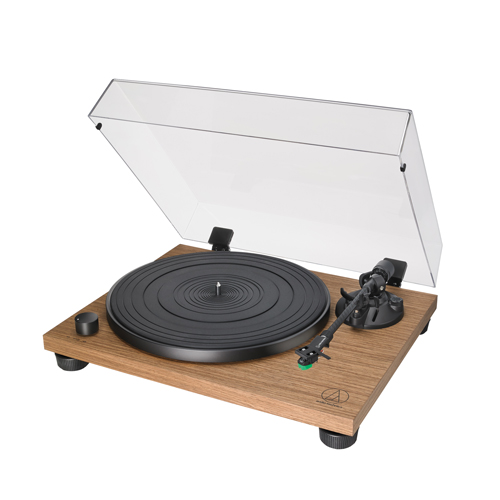
Explore this need in the finder →The AT-LPW40WN is a two-speed, fully manual belt-drive deck with a walnut-look plinth, a carbon-fiber straight tonearm, an AT-VM95E cartridge and a selectable internal phono stage. Its U.S. category entry and U.S. manual identify the exact LPW40WN model. It is not an automatic model, and a speed-sensor feature does not remove the need to cue records by hand. The points below are based on Audio-Technica documents rather than a listening test.
Its package centers on adjustable manual use
The manufacturer lists 33⅓ and 45 RPM and a belt-drive DC-servo motor with active speed stabilization. That wording describes a documented control system, not a speed measurement made for this assessment. The record is still started and stopped using the control, and the listener positions, lifts and returns the arm. Automatic start, arm return and end-of-record platter stop are not stated in the reviewed manual. Anyone who wants unattended end handling should consider a fully automatic product rather than expect this arm to lift itself.
The supplied moving-magnet AT-VM95E uses a bonded elliptical stylus and is mounted to an AT-HS4 universal half-inch headshell. Audio-Technica lists the cartridge within its VM95 replacement-stylus family; a compatible stylus change is not the same as installing a different cartridge. Cartridge replacement can require alignment and careful recalibration. The U.S. manual gives 2.0 g as the supplied cartridge’s standard tracking force and describes balancing the arm and setting tracking force and anti-skate during setup.
Compared with the AT-LPW30, the LPW40WN has a carbon-fiber rather than aluminum tonearm, a sensor-controlled motor and the elliptical VM95E rather than conical VM95C. Those differences may matter to buyers planning stylus upgrades or comparing the supplied setup, but they do not establish that one deck sounds better. The LPW40WN is distinct from the LPW30TK manual variant; this assessment does not transfer its attributes to that other finish/package.
Match the phono switch to the receiving input
The built-in phono preamp can be selected or bypassed. Use PHONO output with a compatible receiver or integrated amp PHONO input, and connect the ground lead. Use LINE output for an AUX/line input or powered speakers with a line input. The manufacturer lists 4.0 mV nominal PHONO output, 200 mV LINE output and 35 dB nominal RIAA gain. These values describe the documented signal route, not the full system: the turntable does not contain speakers or an amplifier for passive speakers. A separate phono stage can also go between PHONO output and a powered-speaker input or an amplifier that drives passive speakers.
The analog RCA cable is removable, which makes exact cable condition and length worth checking on a used unit. It does not add USB or Bluetooth: the LPW40WN's reviewed feature list is a wired analog route only. Buyers who need wireless listening can compare the AT-LPW50BT-RW; those needing computer capture should choose a model with a documented USB output and software path.
Set up the deck before playing
Audio-Technica lists a die-cast aluminum platter, rubber mat, belt, dust cover and hinges, counterweight, headshell/cartridge, 45 adapter, RCA cable and external adapter. The manual asks for assembly: seat the platter, fit the belt correctly, add the mat, attach the cartridge-bearing headshell and counterweight, level the body, then balance and set the arm. Keep the stylus protected during assembly. The 2.0 g standard force is the starting point for the supplied VM95E; another cartridge may need a different setting. If buying used, inspect the stylus and confirm the mat, belt, counterweight, correct headshell/cartridge, dust cover/hinges, cable and regional adapter are present.
Published dimensions are 16.53 inches wide by 13.38 inches deep by 4.60 inches high; listed weight is 4.72 kg without the cover. That is a smaller bare width than the reviewed LP7X, but still reserve room for RCA and power leads, reach to the controls, tonearm movement and cover access. Manufacturer body dimensions are not a clearance diagram. A level, stable surface and distance from vibrating speakers are setup needs, not accessories included in the box.
Who should compare it with the LPW50 models?
The LPW40WN is a sensible model to assess when a wired, manual, two-speed deck with a replaceable VM95E and built-in phono-stage choice is a fit. The piano-black AT-LPW50PB also uses a VM95E and switchable stage but has a heavier, 30 mm piano-black plinth and is taller; the rosewood AT-LPW50BT-RW adds Bluetooth while retaining wired RCA. These are separate configurations, and none turns into an automatic player by sharing family styling.
Check the receiver input type before connecting, decide whether an external phono stage is needed, and confirm the turntable fits with working clearance. The manual's stop sequence and two-speed specification do not support a 78-RPM or hands-off routine. There is no claim here of measured speed, sound quality, personal setup or long-term reliability, and no price or availability conclusion is implied.
Primary references: Audio-Technica U.S. turntable catalog card, Audio-Technica U.S. LPW40WN/LPW30TK manual, and Audio-Technica AT-LPW40WN product details.
Key specifications
Key details at a glance
| Drive | Belt drive |
|---|---|
| 78-RPM play option | No |
| Included cartridge | Audio-technica at-vm95e moving-magnet cartridge on at-hs4 universal headshell |
| Built-in phono preamp | Yes |
| Manual tonearm cueing | Yes |
| End-of-record platter stop | No |
| Removable cartridge body or headshell | Yes |
| Platter | Die-cast aluminum |
| Platter mat | Rubber |
| Body width | 16.53 in |
| Body depth | 13.38 in |
| Body height | 4.6 in |
| Published phono output | 4 mV |
Use the exact model’s instructions for operating limits, supplied equipment and version differences.
Sources for this review
Sources for this assessment

Check your phono route before choosing
Check each model's documented input route, arm operation, and body limits. Use the finder to compare supported phono-system arrangements without assuming adjacent models share features.