
Your needs, this model
Does it fit your priorities?
Can the black Orbit Plus Gen 1 use a receiver PHONO input?
Yes, with the Black / None configuration (SKU 100BKAOR5). The receiver's compatible PHONO input supplies the phono stage; confirm the exact preamp version rather than treating it as interchangeable with the current OA3 Plus.
Explore this need in the finder →Can I connect this model directly to powered speakers?
Only when the Black / Built-in package (SKU 160BKAOR5) is selected, or when you add a separate phono stage. The maker's linked guide says the supplied built-in stage is on out of the box and can be bypassed; send its line output to a powered speaker's analog line input, not a PHONO socket.
Explore this need in the finder →What should I check if my powered speakers need an external phono stage?
Select the no-preamp Black package and place a compatible external phono stage between the turntable's RCA output and the powered speaker's analog line input. The speakers still need their own amplification.
Explore this need in the finder →How does Gen 1 differ from the current Orbit Plus?
The maker distinguishes the first-generation OA2 arm and flat-edge platter from the current OA3 deck with a grooved platter; this is a real operating-part generation difference, not a color option. The Gen 1 page names the OM5E and acrylic platter, while its optional built-in stage is a separate SKU.
Explore this need in the finder →Does this Orbit automatically return the arm or stop the platter?
The maker's FAQ describes the Orbit as fully manual, without auto-return or auto-lift. The exact Gen 1 page and setup guide do not establish a record-end platter stop, so this package should not be selected to satisfy an auto-stop requirement.
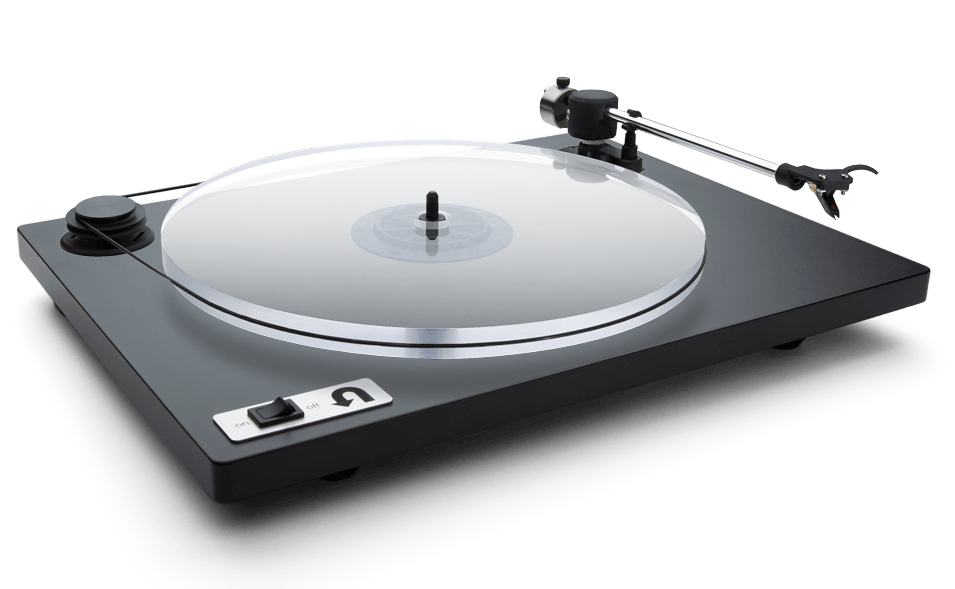
Explore this need in the finder →The Orbit Plus Turntable (Gen 1) is not simply a black finish of U-Turn’s current Plus. The maker keeps a separate first-generation product page and distinguishes it from the later model: Gen 1 uses an OA2 gimbal arm, while the current Plus page identifies an OA3 arm. The older platter edge is also different. This assessment is for the black Gen 1 package shown on that page, not the current OA3 deck and not an unverified used unit. U-Turn says the model is listed “while supplies last,” which describes the maker page—not live stock at a particular seller.
Confirm the generation and the exact phono package
The page identifies two black variants: SKU 100BKAOR5 with no built-in phono preamp, and SKU 160BKAOR5 with the built-in stage. That is a functional distinction, not a naming detail. The first version needs a compatible receiver or integrated-amplifier PHONO input, or a separate phono stage. The built-in version can feed line-input powered speakers directly or connect to an amplifier’s LINE/AUX input. Do not send an enabled built-in stage into a second PHONO input; that applies phono equalization twice. On the version supplied with the stage, U-Turn’s linked setup guide says it is enabled initially and can be switched off with the rear bypass control. Confirm the exact SKU and stage state rather than guessing from a stock photograph, which does not reveal the internal electronics.
There is an important generation check before shopping for a replacement platter or other part. U-Turn’s Orbit setup page distinguishes the first generation by a bare-metal aluminum arm tube and flat-edge platter, and the later generation by its black magnesium OA3 arm tube and belt-grooved platter. The Gen 1 product page calls its arm an OA2 precision gimbal with an adjustable counterweight and internal anti-skate. The current Plus page describes the later OA3 platform. These differences make the two Plus listings different machines, even though both use an acrylic platter and an Ortofon OM5E cartridge. Do not assume the newer platter, arm parts, or setup instructions are interchangeable with a Gen 1 unit; check the maker’s compatibility guidance for the exact part.
What its playback routine asks of the listener
This is a two-speed belt-drive model. To move between 33⅓ and 45 RPM, the owner transfers the belt between the pulley grooves; speed is not selected with an electronic switch. U-Turn’s short setup guide walks through laying the platter on the spindle, attaching the cover hinges, connecting the power adapter and RCA cables, and positioning the belt. It also reminds the installer to avoid pulling the belt or pulley during the process. That simple setup is helpful, but speed changes still involve manual handling.
Arm operation is manual as well. The maker’s FAQ describes Orbit turntables as having no automatic arm return or lift. The Gen 1 product page and its linked manual do not establish an end-of-record platter stop, so a buyer who needs the platter to stop without intervention should choose a model whose exact instructions document that feature. A cue lever is not stated in the Gen 1 page’s box list, so verify whether one is present on an individual offer instead of assuming a current-family accessory is included. This deck is therefore better suited to someone willing to lower and return the arm than to a listener seeking push-button operation.
Cartridge, platter and published specifications
The supplied cartridge is the Ortofon OM5E with an elliptical diamond stylus. The acrylic platter and felt mat are listed for this package; the maker contrasts this Plus with Basic by its cartridge and platter, but that comparison is not a listening test. The Gen 1 product page publishes 0.125% wow and flutter, a -79 dBA signal-to-noise ratio and -63 dBA rumble. Those are the manufacturer’s figures, not measurements taken for this review, and should not be treated as a direct real-room prediction.
U-Turn lists only 33⅓ and 45 RPM for this two-speed platform. A third 78-RPM speed is not documented. If 78 records are part of the plan, that alone rules this package out. Likewise, the described cartridge and tonearm do not guarantee an easy upgrade: before fitting a different cartridge or replacement stylus, verify the exact part, alignment requirements and compatibility for this generation.
System fit and physical space
The maker lists a body measuring 16.75 × 12.5 × 4.25 inches and an input of 115 V / 60 Hz. Treat the dimensions as the body footprint only. Leave more room for opening the cover, reaching the tonearm and speed pulley, routing cables, and placing the deck where it can be level and stable. The deck has RCA output, but it does not contain speaker drivers. A passive-speaker system still needs an amplifier; a powered-speaker system needs a line input when the built-in phono option is used.
The listed box contents are the turntable, AC adapter, RCA cables, dust cover and felt mat. The seller’s exact package may differ, particularly on an older or used unit. Check the spindle/platter, belt, counterweight, cartridge and stylus condition, cover and hinges, adapter, and any cue lever before relying on a listing. U-Turn states a three-year warranty, while its linked 2019 guide describes materials/workmanship coverage; do not assume that warranty transfers or applies to a second-hand purchase. The maker’s published specs and package list cannot establish the condition of an individual machine.
The Gen 1 Orbit Plus makes sense as a precisely identified package when its acrylic platter, OM5E and OA2 arm are the desired combination, and the buyer can live with manual cueing and belt changes. It is a poor shortcut if the shopper actually meant the current OA3 Plus, expects built-in preamp hardware without checking the variant, needs auto-stop or wants 78 RPM. Compare the current Orbit Plus assessment and the Orbit family comparison, then verify the model generation, black preamp SKU and package contents on the exact seller offer. No price, inventory, independent test, ownership or listening experience is asserted here.
Key specifications
Key details at a glance
| Drive | Belt drive |
|---|---|
| Documented record speeds | 33 1/3 RPM / 45 RPM |
| 78-RPM play option | No |
| Included cartridge | Ortofon om5e moving-magnet cartridge with elliptical diamond stylus |
| Built-in phono preamp | Yes |
| Manual tonearm cueing | Yes |
| Platter | Acrylic |
| Platter mat | Felt |
| Body width | 16.75 in |
| Body depth | 12.5 in |
| Body height | 4.25 in |
Use the exact model’s instructions for operating limits, supplied equipment and version differences.
Sources for this review
Sources for this assessment
- U-Turn Audio Orbit Plus Turntable (Gen 1) official U.S. product page
- U-Turn Audio Orbit Turntable Setup Guide (2019, linked from Gen 1 page)
- U-Turn Audio official Orbit turntables collection
- U-Turn Audio current Orbit Plus official U.S. product page (generation comparison)
- U-Turn Audio Orbit Setup generation guide (official browser extraction; direct request rate-limited)
- U-Turn Audio guide to connecting a turntable
- U-Turn Audio Orbit FAQ (official browser extraction; direct request rate-limited)
Check your phono route before choosing
Check each model's documented input route, arm operation, and body limits. Use the finder to compare supported phono-system arrangements without assuming adjacent models share features.