
Your needs, this model
Does it fit your priorities?
Can I connect an Orbit Theory to a receiver's PHONO input?
Yes, if the exact variant is configured with the preamp set to None and the receiver PHONO stage supports the installed Ortofon moving-magnet cartridge. If you choose Built-in and enable the Pluto 2 stage, use a receiver LINE/AUX input instead; do not feed a line-level signal to PHONO.
Explore this need in the finder →Can I connect Orbit Theory directly to powered speakers?
The Built-in Pluto 2 option supplies line-level output for powered speakers with an analog line input. If you choose None, insert a compatible external phono stage before the powered speaker's line input. Check the selected SKU and the speaker's actual inputs.
Explore this need in the finder →Which tracking-force setting does the Theory manual give for its cartridge options?
U-Turn's Theory setup guide specifies 1.75 g for a 2M Blue and 1.5 g for a 2M Bronze or Black. Identify the installed cartridge before setting the tonearm; the same manual lists a medium 0.30 g anti-skate setting for 2M cartridges.
Explore this need in the finder →Does Orbit Theory start and finish a record automatically or stop the platter at the end?
No automatic start, end-of-record arm return or platter auto-stop is documented in the current U.S. product page or Theory manual. The cue lever is a manual aid, and the speed knob only selects 33/45 RPM. Choose an assessment that documents the automation you require.
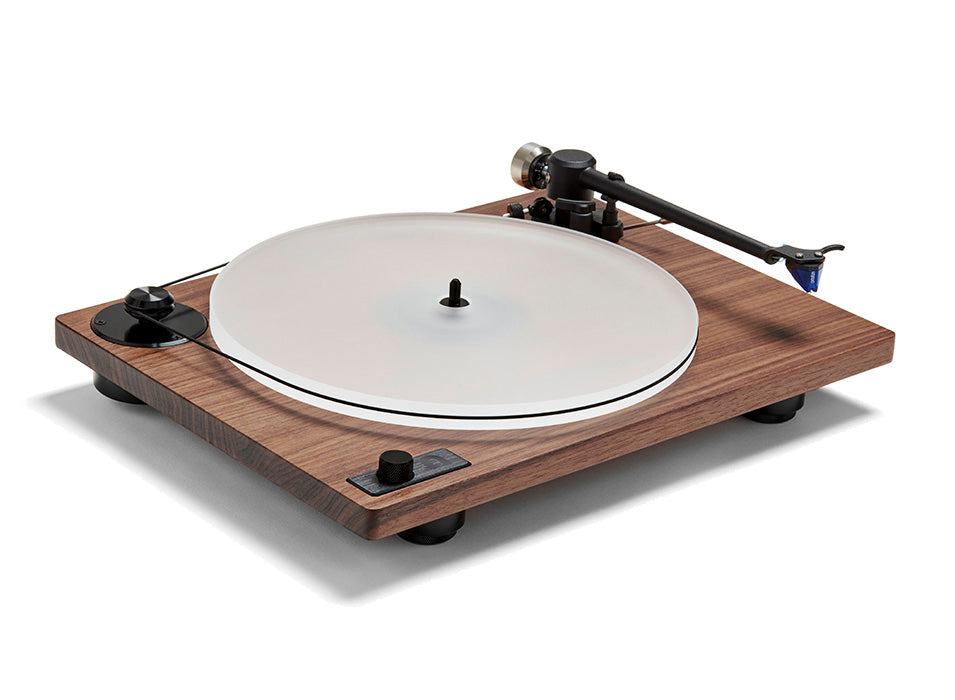
Explore this need in the finder →The Orbit Theory is the most configurable U-Turn deck in the current Orbit collection, but it is still a manually cued, two-speed turntable rather than an automatic record player. U-Turn’s current U.S. product page offers three hardwood finishes, three Ortofon cartridges and a choice of no built-in preamp or its Pluto 2 stage. Those choices are part of the identity of the exact box, not details to assume from a photograph. This is a source-based assessment; I have not listened to, owned or tested the Theory.
Read the options as a family of exact packages
The manufacturer page enumerates eighteen combinations: Walnut, Ebonized Oak or Oak; a 2M Blue, 2M Bronze or 2M Black; and None or Built-in preamp. The available combinations share the Theory platform: a grooved acrylic platter, OA3 Pro magnesium tonearm, electronic 33/45 selector, aluminum Iso-Level feet and an included cue lever. The website’s SKU labels distinguish the exact finish, cartridge and preamp selection. If comparing a seller’s listing, check those parts in the title, photographs and package description rather than treating every “Orbit Theory” offer as identical.
The cartridge choice affects setup as well as the box label. U-Turn identifies the 2M Blue as a nude elliptical, the Bronze as a nude Fine Line and the Black as a nude Shibata. The Theory setup guide specifies 1.75 g tracking force for the Blue and 1.5 g for the Bronze or Black; for all three, it gives a medium 0.30 g anti-skate setting, with adjustable low and high alternatives. Follow the manual for the cartridge actually installed and protect its stylus while balancing the arm. These published differences tell you what is supplied and how the manufacturer says to set it up; they are not a promise that one stylus will sound best with every record or room.
Electronic speed selection does not automate playback
The knob selects 33⅓ or 45 RPM, so speed changes do not require the belt-transfer routine used on U-Turn’s current Basic and Plus. The product page describes a low-noise AC synchronous motor and controller; it publishes wow/flutter, nominal speed deviation, signal-to-noise and rumble figures. Those are manufacturer specifications, not measurements from this assessment. The current Theory product page and its manual list only 33 and 45 RPM; they do not document 78-RPM playback.
The supplied silicone-damped cue lever helps raise and lower the arm, but the listener still starts playback, positions the stylus and lifts it at the end. Neither the current product page nor the Theory setup guide describes automatic start, arm return or record-end platter stop. The speed knob controls platter speed only. If automatic arm handling or an end stop is essential, choose a model whose instructions explicitly document that behavior instead of treating Theory’s premium tonearm or speed control as evidence of automation.
Choose the phono route before selecting the offer
The optional built-in Pluto 2 phono preamp changes how the RCA output should connect. With the preamp set to None, use a compatible receiver or integrated amplifier PHONO input, or add an external phono stage. That external stage can feed powered speakers with a line input, or it can feed an amplifier/receiver LINE input that drives passive speakers. With the Built-in option fitted and enabled, connect the Theory’s line-level output to powered speakers or to an amplifier’s LINE/AUX input. Do not route that enabled line output to another PHONO input. The deck itself does not supply speaker drivers or the power amplifier needed by passive speakers.
U-Turn lists RCA connection, a U.S. 115 V / 60 Hz input and an AC adapter, RCA cables, dust cover and felt mat in the box. Confirm the exact preamp option on the item and the actual inputs on the equipment you already own. For a receiver PHONO route, the selected variant must be None; for a powered speaker’s line input, choose Built-in or plan for a separate stage. A small configuration error can leave an otherwise suitable deck connected at the wrong signal level.
What the body figures do—and do not—settle
The manufacturer lists a body size of 16.75 × 12.5 × 4.25 inches. That is a useful first fit check, but it does not provide the clearance to open the hinged cover, reach the speed knob, move the arm, route RCA cables or make the controls comfortable to use. The adjustable feet and supplied bubble level help with leveling during setup; they do not make an uneven or resonant support disappear. Leave operating room beyond the body and follow the guide’s leveling and arm-balance sequence.
Compared with the current Orbit Basic, Orbit Plus and Orbit Special, Theory adds the OA3 Pro tonearm’s dial counterweight and adjustable anti-skate, hardwood finish choices, Iso-Level feet and three higher-tier cartridge options. The current Custom is a separate build-to-order entry, and Orbit Plus Gen 1 is a distinct earlier design; neither is the same package as Theory. A finish preference or cartridge selection should not obscure the core match: Theory suits a buyer seeking a manually handled deck with electronic two-speed switching and the stated configurable hardware, while its optional preamp and required external amplification path still need to fit the rest of the system.
Before choosing, check the cartridge on the exact offer and use its matching force setting, verify None versus Built-in for the phono chain, measure the surface and allow extra clearance, and confirm that manual cueing is acceptable. U-Turn states a three-year limited warranty; review the maker’s current terms for the particular purchase. No current price, stock, independent performance measurement, listening impression or used-item condition is asserted here.
Key specifications
Key details at a glance
| Drive | Belt drive |
|---|---|
| Documented record speeds | 33 1/3 RPM / 45 RPM |
| 78-RPM play option | No |
| Included cartridge | Selectable ortofon 2m blue, 2m bronze or 2m black moving-magnet cartridge |
| Built-in phono preamp | Yes |
| Manual tonearm cueing | Yes |
| Platter | Acrylic |
| Platter mat | Felt |
| Body width | 16.75 in |
| Body depth | 12.5 in |
| Body height | 4.25 in |
Use the exact model’s instructions for operating limits, supplied equipment and version differences.
Sources for this review
Sources for this assessment
Check your phono route before choosing
Check each model's documented input route, arm operation, and body limits. Use the finder to compare supported phono-system arrangements without assuming adjacent models share features.